
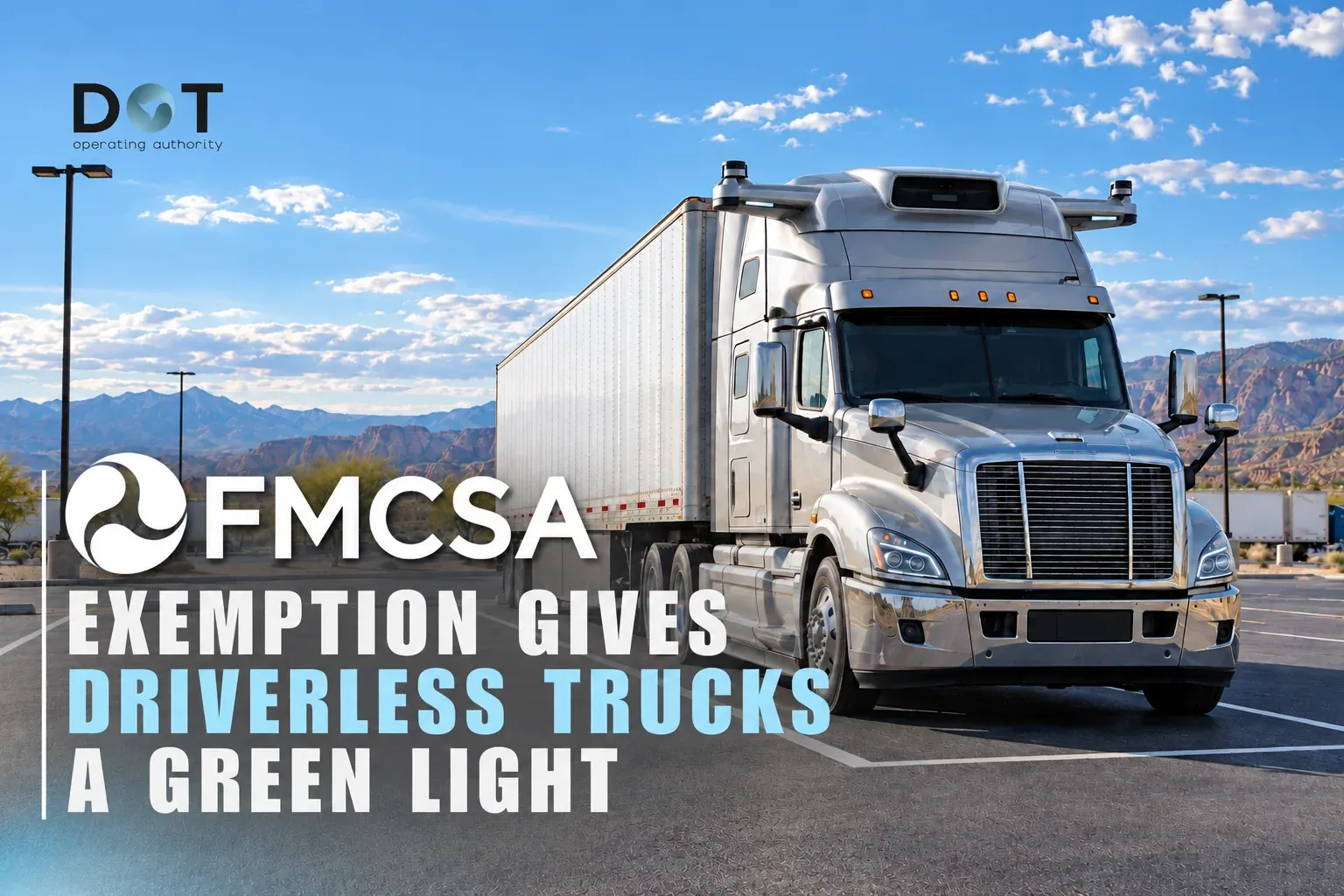
A longstanding truck-safety rule assumes one thing: there is a driver available to step outside the cab. That assumption no longer works for fully driverless trucks. On October 7, 2026, the Federal Motor Carrier Safety Administration granted Aurora Operations and other qualifying operators of Level 4 autonomous trucks a five-year exemption from several federal warning-device requirements. Instead of relying on a driver to place reflective triangles around a stopped truck, covered vehicles can use high-mounted flashing amber warning beacons. The exemption runs through October 7, 2031.
This is not a general federal approval for every self-driving truck or every autonomous operation. It is a narrow exemption dealing with how certain Level 4 commercial vehicles warn approaching traffic when stopped on or beside a highway.
Still, it removes one practical obstacle that has followed driverless trucking for years—and gives the industry a five-year window to show whether the alternative works safely at larger scale.
What Is the Current Status of Autonomous Vehicles?
For this rule, the important category is Level 4 autonomous trucks, not passenger cars or partially automated trucks. FMCSA’s exemption applies to commercial motor vehicles equipped with Level 4 automated driving systems. These vehicles can perform the complete driving task within their validated operational design domain, without depending on a human driver to take over when operating inside those conditions. The exemption took effect October 7, 2026, and allows covered trucks to use cab-mounted flashing amber beacons instead of traditional roadside warning devices. FMCSA concluded that the alternative is likely to provide safety equivalent to or greater than the existing warning-device rules.
The beacon setup is specific. According to FreightWaves, the lights must meet applicable SAE Class 1 photometric standards and be mounted at least 100 inches above the ground, at or above the top of the side mirrors. Trucks need rear-facing warning lights on both sides of the cab and a forward-facing beacon, along with redundant power so one electrical failure does not disable the entire warning system. The beacons must activate as soon as possible and no later than five minutes after the vehicle stops in circumstances where roadside warning devices would otherwise be required. The truck’s standard hazard flashers must remain active as well.
Who Can Use the Exemption, and What Limits Apply?
Aurora is specifically named in the exemption, but the relief is not limited to Aurora. Other motor carriers operating qualifying Level 4 vehicles may use the exemption after giving FMCSA advance written notice and certifying that they will comply with the conditions.
There are also operational limits. The trucks must remain inside their validated operational design domains. The exemption does not cover passenger transportation or hazardous-material operations that would require H, X, P, or S endorsements if a human were driving. Longer-combination operations are also limited. So the current status is not “autonomous trucks can now operate anywhere.” The more accurate takeaway is that qualifying Level 4 operations now have a longer-term federal solution to one specific driverless-truck problem.
Why Warning Triangles Were a Problem Without a Driver
Federal regulations were written around a conventional commercial vehicle with a human driver. When a truck stops on the traveled portion or shoulder of a highway, existing rules generally require warning devices to be placed around it. That creates an obvious problem for a truck with nobody in the cab.
The 10-Minute Rule for Warning Devices
Under the traditional federal setup, a driver of a stopped commercial vehicle must activate the vehicle’s hazard warning flashers and place warning devices within 10 minutes.
FreightWaves notes that the required setup generally involves three bidirectional reflective triangles or another permitted warning-device configuration. One warning device is placed near the vehicle, while others are positioned farther away to alert approaching traffic. The exact placement depends on roadway conditions and direction of traffic. For a driver-operated truck, the procedure is familiar. For a truly driverless vehicle, no person is present to leave the cab, walk along the roadside and place the triangles. That practical conflict is what Aurora’s warning-beacon proposal was designed to address.
Concerns From OOIDA and Truckers
Not everyone agrees that replacing roadside triangles with lights mounted on the truck is an equivalent solution. Aurora’s application generated 402 public comments, according to FreightWaves. Opponents included the Owner-Operator Independent Drivers Association, highway-safety organizations and individual drivers, while supporters included the American Trucking Associations, autonomous-vehicle companies, Volvo Group North America and other organizations. Critics raised scenarios in which cab-mounted lights might become less visible. A truck could overturn. A jackknifed trailer could partially block the lights. Electrical failures could affect the beacons. Weather, roadway geometry and lighting conditions could also affect how approaching motorists perceive a stopped autonomous truck. Land Line characterized the exemption as controversial among truckers and noted opposition to allowing autonomous vehicles to avoid a roadside-warning procedure human drivers continue to perform.
Those concerns are important because the exemption does not prove that every disabled autonomous truck will be handled perfectly. It establishes FMCSA’s conclusion that the alternative system, under the exemption’s conditions, is likely to provide an equivalent or greater level of safety.
Why FMCSA Says Beacons Are Not Worse
FMCSA did not argue that cab-mounted beacons are flawless. Instead, the agency compared their limitations with the weaknesses of traditional warning devices. Triangles can be knocked over, poorly positioned or never placed at all if a driver is injured or unable to leave the truck after a crash.FMCSA also reconsidered studies comparing beacon systems with conventional warning devices. The Federal Register notice says that, although some scenarios showed a slightly lower percentage of motorists responding to beacons, motorists in several scenarios began responding farther from the stopped truck. FMCSA concluded that the overall data supported granting the exemption. Aurora also supplied operational information from an earlier waiver period.
TruckNews reports that 34 Aurora trucks traveled more than 500,000 miles between October 2025 and January 2026. The warning beacons operated for nearly 10 hours during that period, and Aurora reported no beacon faults, malfunctions or power problems. FMCSA also said the vehicles were not involved in crashes while stopped with the beacon system active.
FMCSA therefore decided the available evidence supported a longer exemption—with continuing conditions and reporting requirements.
Aurora’s Waivers and the Court Challenge
The five-year exemption did not appear overnight. Before FMCSA approved long-term relief, Aurora operated under a series of shorter waivers while the agency gathered more information about the warning-beacon system.
Why the Waiver Kept Getting Reissued
FMCSA initially denied a similar five-year request from Aurora and Waymo in December 2024.The agency said at the time that extending relief to a broad class of unspecified carriers using unspecified vehicles and equipment weakened the argument that the system would provide equivalent safety. The regulatory path changed afterward. Starting in October 2025, FMCSA issued Aurora a series of three-month waivers covering the warning-device requirements. FreightWaves reported that four consecutive waivers were issued, with each taking effect after the previous waiver ended. The July 2026 waiver was scheduled to expire at 11:59 p.m. on October 9. The five-year exemption made that serial temporary-waiver process largely unnecessary. Unlike the earlier short-term waivers, the new exemption went through the exemption process, including public notice and comment.
The Giannoulias Lawsuit
The temporary waiver process also produced a legal challenge. Kostas Giannoulias, an Illinois cargo-van operator representing himself, petitioned the U.S. Court of Appeals for the Seventh Circuit in September 2026. He challenged FMCSA’s July waiver, asking the court to halt it and block successor waivers. His arguments accused the agency of exceeding its authority and making an arbitrary and capricious decision. The challenge also asserted that the relief required public notice and comment. The Justice Department called his alleged injury risk speculative. That risk involved encountering a disabled autonomous truck operating under the waiver.
FreightWaves reported on October 2 that the court had not yet ruled on his request. That challenge concerned the temporary waiver framework. The five-year exemption approved on October 7 followed the formal exemption process, including consideration of hundreds of public comments, so it is legally and procedurally distinct from the earlier three-month waivers.
Who Is Leading in Autonomous Trucking?
Aurora is central to this exemption because it filed the application and supplied much of the operating data used by FMCSA. But it is not the only company moving toward commercial autonomous trucking. During the earlier waiver period, Kodiak, Waabi and Stack AV also opted into the warning-beacon relief. FreightWaves reported before the five-year exemption that Kodiak had deployed 20 driverless trucks as of March 10, while Waabi and Stack AV had deployed none as of July 31 under the figures cited in the government’s court response. Aurora, meanwhile, had told FMCSA that it expected to operate more than 200 Level 4 trucks by the end of 2026. Those figures should not be combined as if they represent one standardized fleet count. Different sources may count commercial operations, deployed vehicles, trucks covered by an exemption or trucks actively operating without a driver in different ways. The larger point is more useful: Driverless freight is no longer only a testing concept. Limited commercial deployment is already happening, particularly on selected freight corridors where companies believe road, weather and operating conditions fit their automated systems.
What Is the Future of Autonomous Trucking?
The October decision is notable partly because FMCSA had rejected similar relief less than two years earlier. In December 2024, the agency denied the Waymo/Aurora exemption request. By October 2026, after temporary operations, new data, updated conditions and another public-comment process, FMCSA reached the opposite conclusion and approved the five-year exemption. That reversal shows how quickly the regulatory framework around self-driving trucks is developing.
It also raises a larger question about warning devices for conventional commercial vehicles. During the exemption proceeding, industry commenters argued that high-mounted warning beacons could potentially improve safety on human-driven trucks too. FMCSA responded that updating warning-device requirements across commercial vehicles may be appropriate for future regulatory action. In other words, the autonomous-truck exemption could eventually influence rules beyond autonomous vehicles. For now, FMCSA will have several years of additional crash, malfunction, beacon-use and operational data before the exemption expires in October 2031. The exemption also preempts states from enforcing conflicting requirements against covered interstate operations. That does not eliminate every state issue surrounding autonomous trucking, but it creates one federal standard for the specific warning-device requirements covered by the exemption.
How Close Are We to Autonomous Trucking?
Closer than a few years ago but still far from a situation where every carrier can purchase a driverless tractor and send it anywhere in the country. The exemption creates a pathway for other operators, not an automatic approval. A carrier seeking to operate under the relief must use qualifying Level 4 ADS-equipped commercial vehicles, install beacons that meet the exemption’s technical specifications, remain inside the vehicle’s validated operational design domain, follow the exemption’s operating conditions, and notify FMCSA before beginning covered operations. That means the five-year exemption solves one regulatory issue. It does not solve all of them. Autonomous trucking still has to deal with questions involving vehicle safety, state rules, roadside inspections, emergency response, liability, maintenance, insurance, operational design domains and public acceptance.
It also does not answer the bigger question many drivers ask: will autonomous trucks replace drivers? The current exemption provides no timeline for that.
What Does FMCSA’s Exemption Mean for the Future of Autonomous Trucks?
What it does show is that FMCSA is increasingly willing to adapt regulations that assume a person is physically present in the truck when an autonomous system can demonstrate a workable alternative. That is a meaningful regulatory change. It is not the same thing as nationwide driverless trucking.
FMCSA’s new five-year exemption removes one specific obstacle facing Level 4 autonomous trucks. From October 7, 2026, through October 7, 2031, qualifying operators can use approved cab-mounted amber warning beacons instead of relying on a human driver to place traditional warning devices around a stopped truck. For carriers considering the exemption, the practical questions are straightforward: Is the vehicle operating at Level 4? Do its warning beacons meet the required specifications? Will the truck remain within its validated operational design domain? Is the operation outside the excluded passenger and hazardous-material categories? And, for a carrier other than Aurora, has the required advance notice been submitted to FMCSA? The bigger story will develop over the next five years.
FMCSA will have more operational data, more real-world stopped-truck events and more evidence about whether beacon systems perform as intended. By the time the exemption reaches its October 2031 expiration date, that record may help determine whether warning triangles remain the standard for autonomous trucks—or whether the rules themselves are ready for another change.