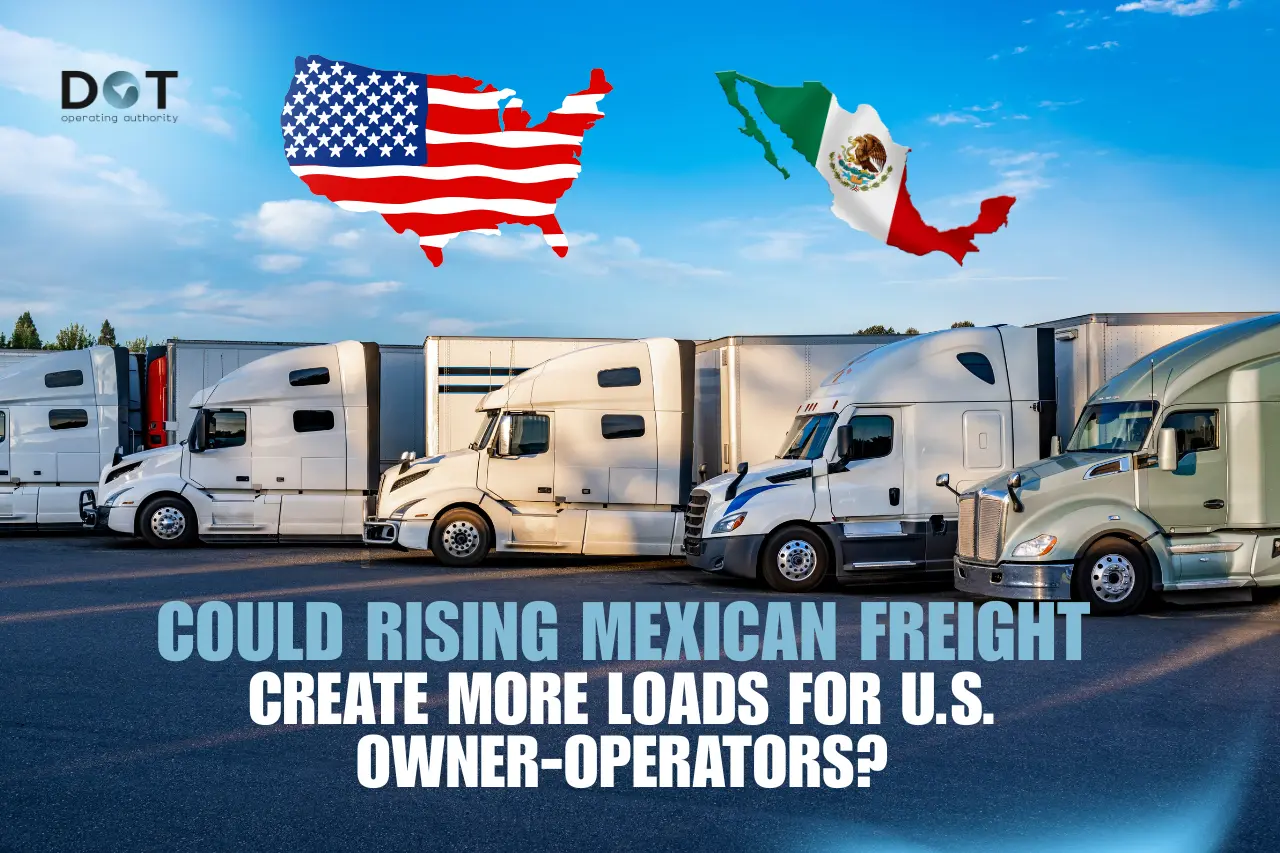
Freight moving between the United States and Mexico is growing in value, while one part of the cross-border driver pool is reportedly getting smaller. For U.S. carriers and owner-operators, that combination is raising a practical question: could more Mexican freight eventually mean more domestic loads north of the border? There are signs that opportunities could develop, particularly around South Texas and transloading operations. But the numbers do not guarantee more freight or better-paying freight for every carrier. Lane balance, equipment type, operating authority, customer relationships, border capacity, deadhead miles, and costs still determine whether a load actually makes business sense. The opportunity is worth watching. It just needs to be separated from the headline numbers.
Mexican Freight Growth Sets the Background
The latest Bureau of Transportation Statistics data show substantial U.S. Mexico trade activity. In August 2026, trucks moved $73.9 billion in freight between the United States and Mexico. Across both the Mexican and Canadian borders, trucks carried $109 billion, up 29.8% from August 2025. Total U.S.–Mexico freight across all transportation modes reached $94.3 billion, an increase of 26.7% year over year.
Those are significant numbers, but they need to be interpreted carefully.BTS measures the value of freight, covering both imports and exports. A 29.8% increase in the value of truck freight across both borders does not mean the number of truckloads rose 29.8%. It also does not mean Mexican imports alone increased by that amount.Still, trucks remain central to U.S.-Mexico trucking. BTS identified Laredo, El Paso, and Otay Mesa as the top truck ports for U.S. freight flows with Mexico in August.
For owner-operators, that makes the southern border and especially Texas a market worth monitoring. Growth in cross-border freight can create demand at several stages of the move. A Mexican carrier may handle one portion, freight may cross in the same trailer, or the shipment may be transferred at a border facility before a U.S. carrier handles the domestic leg. That last arrangement is receiving more attention.
What Is Happening to B-1 Driver Availability?
Uber Freight says the pool of B-1 drivers used in some U.S.–Mexico freight movements has contracted significantly. Kyle Toombs, Uber Freight’s senior vice president of capacity solutions, estimated that roughly 20,000 B-1 drivers lost their visas between April 2025 and April 2026, with approximately 5,000 more losing visas afterward. That brings his industry estimate to roughly 25,000 drivers. Uber Freight says many of the more recent losses were connected to English-proficiency requirements. That figure should be treated as an industry estimate, not an official government count of every B-1 visa loss involving a commercial driver.
B-1 status is also limited. A B-1 visa is a business-visitor classification. The U.S. Department of State says B-1 visitors may engage in qualifying business activities, but the classification generally does not authorize employment or ordinary domestic work in the United States. For cross-border trucking, that distinction matters. B-1 truck drivers may participate in qualifying international freight movements, but the visa should not be understood as general permission to pick up and deliver unrelated domestic U.S. freight.
Why Could That Matter to U.S. Owner-Operators?
The shrinking B-1 pool is encouraging some shippers to reconsider how freight moves after crossing the border. Uber Freight says transloading has shifted from being an emergency workaround to something shippers increasingly build into their cross-border networks. Instead of relying entirely on one through-trailer arrangement, freight can move to a border facility, be transferred into another trailer, and continue through the United States with a domestic carrier. Uber Freight reported three capacity disruptions in Laredo during 2026 in which customers heavily dependent on B-1 drivers faced backlogs. It says customers with transloading capability had another way to move the freight.
That is where potential owner-operator opportunities enter the picture. U.S. carriers do not necessarily have to operate in Mexico to participate in Mexican-origin freight. Depending on how the shipment is structured, a domestic carrier may pick up a transloaded shipment on the U.S. side and move it to an inland destination. Land Line reported Toombs describing South Texas in particular as an area of potential opportunity, as some freight shifts from through-trailer movements toward transloading. That does not mean every owner-operator near Laredo will suddenly see more profitable loads. Before booking this type of South Texas freight, carriers still need to evaluate:
- Pickup and delivery locations
- Deadhead to the border market
- Trailer and equipment requirements
- Detention and cross-dock timing
- Commodity and cargo-insurance requirements
- Rate per loaded and total mile
- Reload opportunities
- Broker or shipper payment terms
- Whether the lane fits the carrier’s operating authority
A growing freight market can create possibilities without making every load worth taking.
How Does Transloading Change the Opportunity?
Traditionally, some cross-border shipments remained in the same trailer while different tractors or drivers handled different portions of the route. Transloading creates another model. Freight moves to a warehouse or cross-dock near the border and is transferred from one trailer into another. That can allow a Mexican-side movement and U.S. domestic movement to be arranged separately. Uber Freight argues that this adds capacity rather than simply replacing through-trailer service. It also says shippers are looking beyond Laredo and considering other border locations, including El Paso, as they diversify transloading capacity.
That matters for U.S. carriers because it potentially separates the domestic portion of freight shipping from Mexico from the international driver arrangement. However, transloading also adds another handoff. Shippers, brokers, Mexican freight forwarders, warehouses, and carriers need to coordinate appointment times, product handling, trailer availability, documentation, and cargo integrity. For an owner-operator, the key question is not simply whether a load originated in Mexico. It is whether the U.S. leg fits the business.
Does Canadian Freight Offer the Same Opportunities?
The northern border looks different. Land Line reported that Toombs sees fewer direct openings for U.S. carriers in Canadian cross-border freight. He estimated that Canadian drivers handle more than 90% of trucking freight across the northern border, while emphasizing that the figure was anecdotal rather than a verified government statistic. Canadian freight has recently shown year-over-year growth as well. BTS reported $35.2 billion in U.S.–Canada truck freight in August 2026. But the structure of that market and the existing carrier base differ from the U.S.–Mexico border. Tariff uncertainty can also affect when freight moves and may contribute to temporary frontloading or changes in trade patterns.
So the comparison should not be reduced to “Mexico is growing, Canada is not.” The more useful distinction is this: verified freight-value growth shows that significant cross-border commerce is moving, while industry participants see a more specific capacity issue developing around B-1-dependent U.S.–Mexico freight. That capacity issue may create openings for certain U.S. carriers.
What Should Owner-Operators Check Before Chasing Mexican Freight?
The headline opportunity is attractive: more cross-border trade, fewer available B-1 drivers, and more transloading on the U.S. side.But Mexican freight should be evaluated the same way as any other lane. Start with the rate and total mileage, not the border story. Check where the U.S. pickup actually occurs. A load advertised as cross-border freight may involve a pickup at a warehouse in Laredo rather than any international movement by the U.S. carrier.
Calculate deadhead both before and after the load. Ask whether the facility commonly has delays and whether detention is paid. Confirm cargo value, insurance requirements, trailer type, and appointment restrictions. And look hard at the return lane. Uber Freight points to an imbalance between northbound and southbound activity, which can create costly empty miles when capacity cannot find suitable freight moving the other direction. For small carriers, owner-operator opportunities are valuable only when the complete lane economics work.
There is a real shift worth watching at the southern border. BTS reported $73.9 billion in truck freight between the U.S. and Mexico in August 2026, while Uber Freight estimates that about 25,000 B-1 drivers have lost visas since April 2025. At the same time, shippers are increasingly considering transloading as part of their regular cross-border networks.Together, those trends could create more domestic freight opportunities for some U.S. carriers, particularly around South Texas and other major border gateways.
But freight value is not the same as load volume, and a capacity shortage does not automatically produce profitable freight for every truck.For an owner-operator, the opportunity still comes down to the individual lane: rate, equipment, deadhead, detention, reload potential, customer reliability, and operating costs. Mexican freight may be opening new doors. The important part is making sure the load on the other side of that door actually works for your business.