
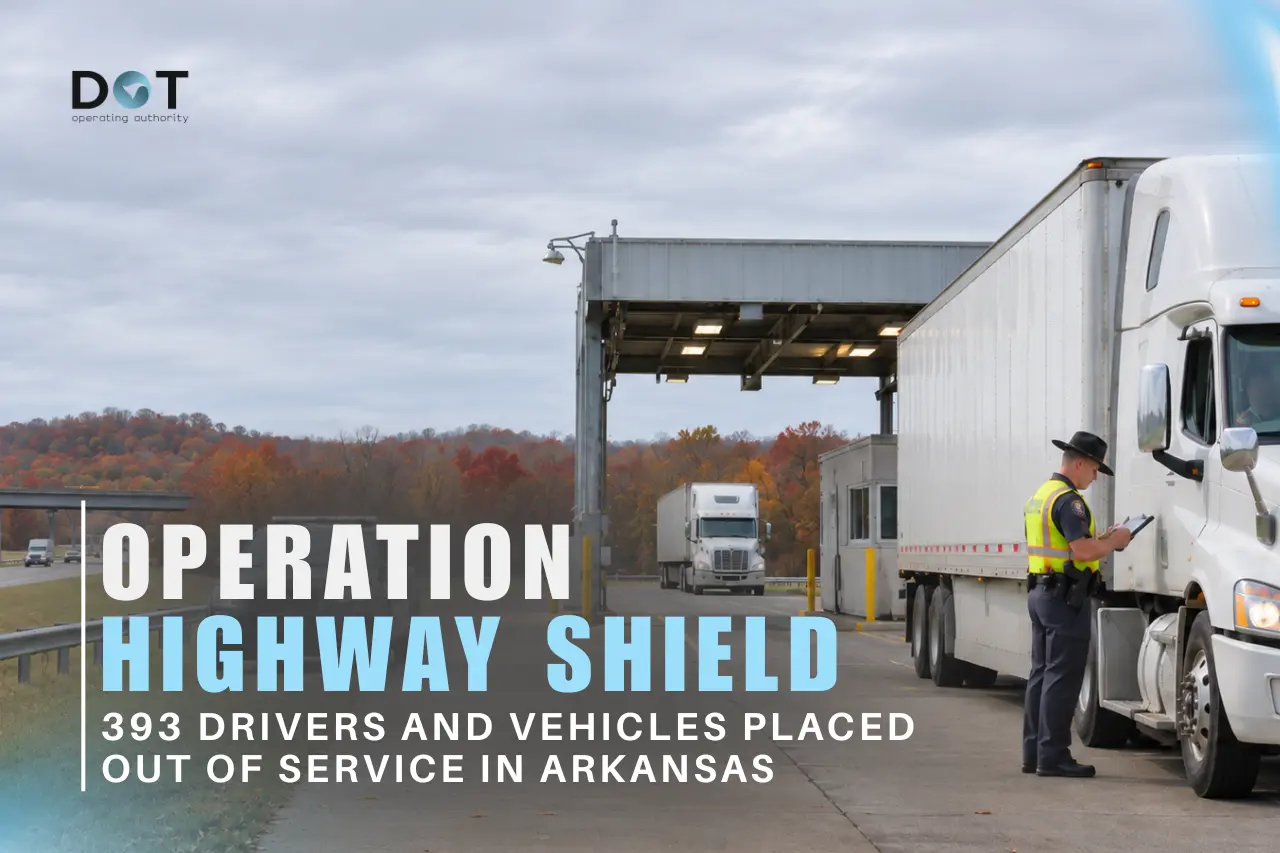
A 48-hour commercial vehicle enforcement operation in Arkansas ended with hundreds of drivers and vehicles sidelined and dozens of criminal and immigration-related cases referred for further action. FMCSA announced the latest Operation Highway Shield results on November 4, 2026, after federal and state agencies completed 1,724 commercial vehicle inspections across Arkansas. The agency reported that 393 drivers and vehicles were placed out of service during the operation.
Inspectors also recorded 183 English Language Proficiency violations, while separate enforcement activity resulted in immigration referrals and criminal arrests.
This was the third wave of Operation Highway Shield, an FMCSA-led enforcement initiative combining commercial vehicle inspections with broader federal and state enforcement activity. FMCSA’s November 4 release describes the Arkansas effort as a 48-hour operation, but it does not specify the exact calendar dates on which the inspections took place. November 4 is the announcement date, not necessarily the date the operation began or ended.
What Did Operation Highway Shield Find in Arkansas?
FMCSA reported the following results from the Arkansas operation:
- 393 drivers and vehicles placed out of service
- 183 English Language Proficiency violations
- 74 immigration violations referred for federal immigration enforcement
- 44 criminal arrests
- One stolen trailer recovered
The categories should be read separately. The 393 figure is a combined total of drivers and vehicles placed out of service. It is not a count of 393 truck drivers. Likewise, the 183 English Language Proficiency violations should not simply be added to the 393 figure as if they represent an entirely separate group of drivers or vehicles. The 74 immigration matters were reported as violations referred for federal immigration enforcement. The 44 criminal cases were reported as arrests, not convictions. Those distinctions matter when interpreting the Operation Highway Shield results. The operation involved 1,724 FMCSA truck inspections over 48 hours, making it a concentrated enforcement action rather than a routine single-site inspection detail.
Which Agencies Participated in the Arkansas Operation?
Operation Highway Shield brought together several federal and state agencies.
FMCSA inspectors worked with:
- Homeland Security Investigations
- Immigration and Customs Enforcement
- Drug Enforcement Administration
- Arkansas Highway Police
FMCSA said the operation targeted unsafe drivers, hazardous commercial vehicles, fraudulent practices, and other potential criminal activity along Arkansas highways and major freight corridors.
That makes the Arkansas operation broader than a standard roadside safety check.A conventional commercial vehicle inspection may focus heavily on driver credentials, hours of service, brakes, tires, lighting, cargo securement, and other Federal Motor Carrier Safety Regulations. Operation Highway Shield combined those types of Arkansas truck inspections with participation from agencies responsible for immigration enforcement, criminal investigations, and drug enforcement. The result was therefore both a commercial truck inspection blitz and a coordinated multiagency enforcement action.
Why Were English Language Proficiency Violations Significant?
One of the largest violation categories reported during the Arkansas operation involved English Language Proficiency, or ELP.FMCSA reported 183 ELP violations during the 48-hour enforcement action.The underlying driver qualification requirement is not new.Under 49 CFR §391.11(b)(2), a driver subject to the qualification rules must be able to read and speak English sufficiently to communicate with the general public, understand highway traffic signs and signals written in English, respond to official inquiries, and make entries on reports and records.FMCSA’s current roadside policy gives enforcement personnel guidance for evaluating that requirement during North American Standard driver and vehicle inspections. The agency’s April 16, 2026 memorandum, MC-SEE-2026-0002, replaced its May 20, 2025 enforcement policy.
The policy focuses on two central abilities: Responding sufficiently to official inquiries in English. Understanding highway traffic signs and signals written in English. The Arkansas announcement reports enforcement results under the existing requirement. It does not establish a new FMCSA English language requirement. FMCSA has since issued updated FAQs dated October 6, 2026, clarifying how its roadside ELP enforcement policy applies in several situations. The underlying April 16 enforcement memorandum remains the policy identified by FMCSA as MC-SEE-2026-0002. The 183 violations also should not be treated as evidence that every driver failed the requirement in exactly the same way. The public Arkansas release reports the total number of ELP violations but does not provide an individual breakdown of the circumstances behind each one.
How Does Arkansas Follow Earlier Highway Shield Operations?
Arkansas was the third wave of Operation Highway Shield. The second wave took place from July 28 through July 30, 2026, across Illinois, Indiana, Iowa, and Ohio. According to the U.S. Department of Transportation, that operation resulted in:
- 766 drivers and vehicles placed out of service
- 36 English Language Proficiency violations
- 51 immigration detentions
- Nearly $1 million in stolen cargo recovered
The Arkansas operation later reported 393 combined driver-and-vehicle out-of-service actions from 1,724 inspections. Those numbers should not be used as a direct performance comparison. The operations covered different states, road networks, inspection populations, and time periods. Raw totals therefore do not establish that overall trucking compliance became better or worse between the second and third waves. FMCSA also reported an earlier Florida wave in March 2026, where more than 3,300 inspections resulted in 176 drivers being placed out of service, including 54 for language deficiencies.
Together, the operations show that Highway Shield has developed into a continuing multi-state truck enforcement operation, rather than a single enforcement event.
Separate Enforcement Blitzes Targeted Truck Safety Across North America
Operation Highway Shield is also taking place during a broader period of intensified commercial vehicle inspections.
A FreightWaves roundup published October 2 covered separate enforcement operations conducted from mid-September through October 1 in the United States and Canada.
Across the actions included in that roundup, authorities reported at least 124 drivers and 226 commercial vehicles or loads placed out of service. Those totals came from multiple unrelated operations and should not be confused with the Arkansas Highway Shield results.
For example, Illinois State Police conducted a two-day hazardous-materials enforcement detail that included 532 inspections, with 30 drivers and 60 vehicles placed out of service.
Arizona authorities conducted 46 commercial vehicle inspections along Interstate 10 near Quartzsite and Ehrenberg. They placed 11 drivers and 13 commercial vehicles out of service.
In Canada, inspectors in Strathcona County, Alberta, examined 192 commercial vehicles during a three-day operation and placed 77 vehicles out of service. Other operations in the roundup involved brakes, tires, commercial driver’s licenses, cargo securement, oversize permits, hours-of-service records, and distracted driving. These were separate enforcement actions with different agencies, inspection criteria, and jurisdictions. They provide broader context for current trucking enforcement, but their numbers should not be added to Operation Highway Shield and reported as one national enforcement total.
What Should Trucking Companies Review?
For fleet managers, one practical takeaway from the Arkansas operation is the importance of reviewing driver qualifications before a roadside inspection exposes a problem. Under 49 CFR §391.11(a), motor carriers may not require or permit someone to drive a commercial motor vehicle unless that person meets the applicable qualification requirements. FMCSA specifically recommends that carriers assess a driver’s English proficiency as part of the qualification process when the ELP requirement applies. The agency recommends discussing topics that a driver may need to explain during roadside enforcement, including:
- Trip origin and destination
- Time spent on duty and driving
- Record-of-duty-status information
- Driver’s license information
- Shipping papers
- Vehicle equipment
- Highway traffic signs
What Carriers Should Check Before Dispatch
FMCSA also recommends showing drivers examples of highway and dynamic-message signs and asking them to explain their meaning. However, this distinction is important: The driver qualification requirement is regulatory, but FMCSA’s suggested interview process is guidance. FMCSA explicitly states that the guidance is not independently legally binding and is not itself a separate basis for an enforcement action or penalty. Carriers therefore have flexibility in how they assess compliance, while remaining responsible for using drivers who satisfy the underlying qualification requirements. Before dispatch, carriers may also want to review broader motor carrier compliance items that frequently appear during commercial inspections:
- CDL status and required endorsements
- Driver qualification records
- Hours-of-service and ELD records
- Vehicle inspection and maintenance condition
- Cargo securement
- Shipping documentation
- Applicable English proficiency requirements
Operation Highway Shield went beyond routine checks. Still, carriers can address basic driver and vehicle compliance before trucks reach an inspection point. The third wave combined roadside safety inspections with driver qualification reviews and multiagency investigations. For carriers, the practical response is not to focus only on the headline number of out-of-service orders.
The goal is to make sure drivers and vehicles are ready for an inspection. Drivers should meet applicable qualification requirements and have current credentials. Hours-of-service records should be accurate. Vehicles should not leave the terminal with unresolved safety defects.
The Arkansas operation also highlights the importance of reviewing current FMCSA guidance. Pay particular attention to enforcement policies changed or clarified during 2026. Identify qualification and documentation problems before dispatch, rather than discovering them during a roadside inspection.