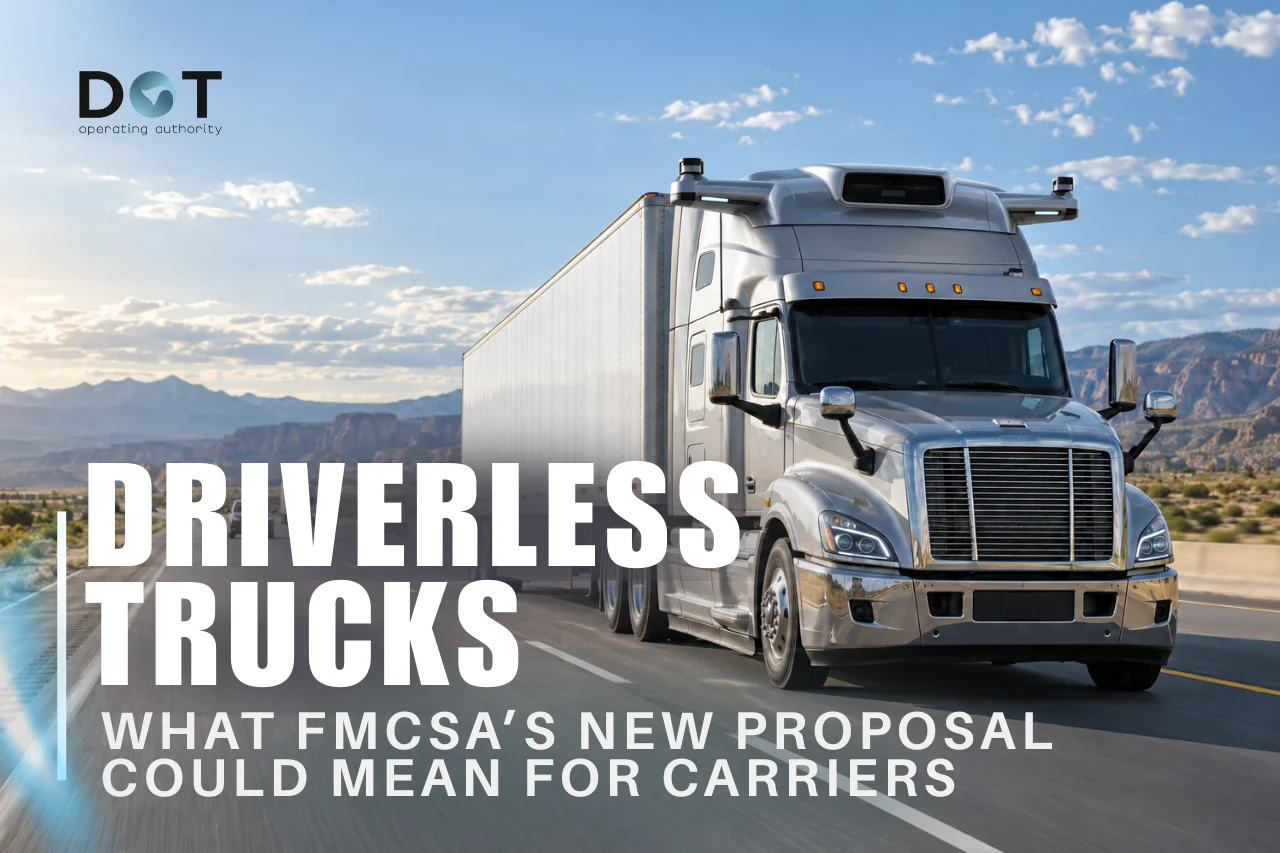
Driverless trucks are no longer limited to closed test tracks and futuristic concept videos. Some are already hauling freight on selected U.S. routes, while federal regulators are working out how decades-old commercial vehicle rules should apply when there is no human sitting behind the wheel. FMCSA is now moving toward a formal proposal titled Motor Carrier Operation of Automated Driving Systems (ADS)-Equipped Commercial Motor Vehicles. According to the federal regulatory agenda, the agency is considering changes involving commercial vehicle operations, inspection, repair, and maintenance to account for the differences between human drivers and automated driving systems.
As of August 21, 2026, the proposal itself has not yet appeared among FMCSA’s published proposed rules, although the Unified Agenda targets August 2026 for the notice of proposed rulemaking. That distinction matters. FMCSA has signaled where the rulemaking is headed, but the actual proposal will determine what changes the agency wants to make and what carriers, developers, drivers, and safety groups will be asked to comment on.
What Are FMCSA Regulations Proposing for Driverless Trucks?
FMCSA’s planned rulemaking focuses on how the Federal Motor Carrier Safety Regulations should work when a commercial vehicle is equipped with an automated driving system capable of performing tasks traditionally handled by a human driver. The agency’s regulatory agenda says it expects to consider amendments involving CMV operations, inspection, repair, and maintenance. The stated goals include safety and security, supporting innovation, creating a more consistent regulatory approach, and recognizing that automated systems and human drivers do not operate in the same way. That does not mean FMCSA has already decided what every future driverless semi truck must do. The NPRM will be the point where those proposed requirements become much more specific.
Why FMCSA Is Moving Toward a Formal Proposal
This rulemaking did not begin in 2026. FMCSA issued an advance notice of proposed rulemaking in May 2019, asking which existing regulations might need to be amended, revised, or removed to accommodate ADS-equipped commercial vehicles safely. The agency specifically recognized that regulations written around human operators may not always translate neatly to automated systems.
FMCSA returned to the subject in February 2023 with a supplemental advance notice of proposed rulemaking. That second notice asked for more information about the regulatory framework needed for ADS-equipped CMVs. An advance notice is largely an information-gathering stage. Regulators ask questions, receive comments, and study possible approaches. A notice of proposed rulemaking is more concrete. It tells the public what regulatory changes the agency is actually proposing and opens those proposals for formal comment. The 2026 Unified Agenda now lists the rule at that proposed-rule stage.
What Federal Motor Carrier Safety Regulations Could Change?
The regulatory agenda identifies several parts of the FMCSRs that could be involved, including Parts 382, 383, 390, 392, 393, and 396. Those areas touch subjects such as drivers, commercial vehicle operation, equipment, inspection, repair, and maintenance. The challenge is that many existing rules assume a person is physically present. Consider a disabled truck. Traditional rules can require a driver to take actions such as placing warning devices around a stopped commercial vehicle. FMCSA has previously received exemption requests from Aurora and Waymo involving warning-device requirements because a fully driverless vehicle cannot physically step onto the shoulder and place reflective triangles. That is exactly the type of practical mismatch a federal ADS framework may need to address. The upcoming proposal should therefore be read as an attempt to adapt existing safety rules, not as permission for autonomous trucks to ignore them.
What Are the Major Challenges Facing Autonomous Vehicles?
The hardest questions about autonomous trucks are not limited to whether software can keep a truck centered in a lane. Real freight operations involve breakdowns, bad weather, damaged sensors, maintenance problems, roadside emergencies, police interactions, loading facilities, and situations nobody planned for that morning. Those operational details become more complicated when the driver’s seat is empty.
Driverless Semi Trucks and Roadside Safety
Imagine a conventional tractor-trailer develops a tire problem on an interstate. The driver can recognize something is wrong, choose a safe place to stop, activate warning lights, inspect the vehicle, contact dispatch, communicate with roadside assistance, and place warning devices. A driverless semi truck has to replace those functions with a combination of automated systems and external support.
FreightWaves has highlighted several unresolved questions, including how autonomous fleets detect failures, dispatch roadside personnel, maintain sensors, and handle a disabled 80,000-pound vehicle when no human is present to perform physical roadside tasks. Sensor condition also becomes part of routine safety. Cameras, lidar, radar, software, braking systems, steering systems, and redundant power systems all need maintenance and monitoring. Dirt, moisture, component failure, or damage can affect systems that the vehicle depends on to perceive its surroundings. For carriers, that means autonomous truck maintenance may eventually involve much more than the traditional engine, brakes, tires, and suspension inspection routine.
What Happens When No Driver Is in the Cab?
Emergency response raises another question. What happens when a police officer, firefighter, tow operator, or highway patrol officer reaches an autonomous truck and there is nobody to talk to? Remote assistance is one possible part of the answer. Operations centers can receive information from the vehicle, communicate with authorities, and dispatch support personnel. But the process has to work quickly and reliably. First responders may also need ways to identify the vehicle’s status, communicate with the operator responsible for it, determine whether it can move, and safely disable or approach the automated system. These problems do not prove that autonomous commercial vehicles cannot operate safely. They show that automated driving systems require an operational support structure beyond the technology that actually steers the truck.
Where Are Self Driving Trucks Already Operating?
The federal framework may still be developing, but self driving trucks are already moving beyond basic experiments. Texas has become one of the most visible areas for commercial deployment.
Aurora has operated driverless Class 8 trucks in commercial freight service on Texas routes, while expanding its autonomous network across additional Sun Belt corridors. Its 2026 operations include commercial and planned deployments connecting markets such as Dallas, Houston, Laredo, Fort Worth, Phoenix, and other freight hubs. Kodiak has also operated driverless trucks in industrial freight operations in the Permian Basin and has been working toward broader long-haul autonomous deployment.
Self Driving Semi Trucks in Current Freight Operations
It is important not to put every autonomous operation into the same category. Some self driving semi trucks are operating without a safety driver. Others are running in supervised autonomy with a person in the cab. Some programs are testing technology, while others are already hauling paying freight.
For example, Volvo Autonomous Solutions and Aurora began operating a Dallas-to-Oklahoma City route in 2026 using supervised autonomous trucks while working toward further driverless validation. Meanwhile, FreightWaves reported in May that Aurora was already operating commercial driverless Class 8 trucks between Dallas and Houston, while Kodiak was running driverless operations in the Permian Basin. The common theme is limited operating domains. Today’s deployments tend to concentrate on particular freight corridors, routes, weather conditions, terminals, and operating models rather than allowing an autonomous tractor to accept any load to any destination in the country.
How Autonomous Vehicle Regulations Differ by State
The state rules are just as varied as the operations themselves. California provides a useful example. In April 2026, California adopted new autonomous vehicle regulations that removed the previous prohibition preventing autonomous vehicles over 10,000 pounds from progressing into heavy-duty testing and deployment.The new system uses a staged approach.
Manufacturers must first conduct heavy-duty autonomous testing with a safety driver. They can then progress toward driverless testing and, after satisfying additional requirements, apply for commercial deployment. California also established testing-mileage requirements, safety-case requirements, and rules for remote operations personnel. Other states take different approaches. Texas, Arizona, Michigan, Ohio, and others have allowed various forms of testing or commercial autonomous operations, while lawmakers in several states have considered proposals that would require a human operator to remain inside autonomous commercial vehicles.
Why a Federal Framework Matters for Autonomous Trucks
Interstate trucking does not stop at state borders, but autonomous vehicle rules often do.
That creates one of the strongest arguments for clearer federal autonomous vehicle regulations. A truck traveling hundreds of miles through multiple states could encounter different testing, permitting, deployment, remote-operation, or driver-presence requirements along a single freight corridor. The Arizona Capitol Times reported in August 2026 that states are continuing to take different approaches as autonomous deployment expands. Some lawmakers have pursued “driver-in” requirements, while other states have opened paths for driverless operation. California’s new system alone shows how detailed state regulation can become, with separate stages for drivered testing, driverless testing, and eventual commercial deployment. FMCSA’s planned rulemaking will not necessarily erase every state difference. States retain important authority over their roads and vehicle operations.
But clearer federal rules could establish more consistent expectations for areas that fall directly under the FMCSRs, particularly commercial vehicle operation, equipment, inspection, repair, and maintenance. For interstate carriers considering driverless trucking, that consistency could become increasingly important as autonomous routes expand across state lines.
Are Self-Driving Trucks Going to Replace Truck Drivers?
This is probably the biggest question surrounding autonomous trucking, and there is no reliable date when someone can say, “truck drivers disappear.” Supporters of autonomous trucking argue that the technology can improve safety, increase equipment utilization, add freight capacity, and address difficult-to-fill long-haul driving positions. Professional drivers and labor organizations see another side of the story. The Teamsters and other critics have raised concerns about job displacement and have supported legislation requiring human drivers in autonomous commercial vehicles. In August 2026, Teamsters California was also challenging California’s new autonomous vehicle regulations in court. But current deployment does not look like an overnight replacement of the nation’s truck-driving workforce.
Autonomous operations remain concentrated on defined routes and operating environments. Even a truck capable of highway driving without a person in the cab does not automatically handle every task a professional driver performs. Drivers interact with customers and warehouse personnel. They inspect equipment. They respond to damaged freight and mechanical problems. They handle unexpected facility conditions, load changes, weather, parking, roadside emergencies, and situations that do not fit neatly into a predefined operating domain.
FreightWaves notes that many current autonomous long-haul operations still rely on people for first-mile, last-mile, facility, maintenance, and support functions even when the highway portion can be performed without a driver. The employment impact could become significant as the technology scales, and concerns about displacement deserve to be taken seriously. But FMCSA’s upcoming rulemaking is not a decision about when truck drivers will be replaced. Its immediate purpose is much narrower: determining how federal commercial vehicle safety rules should work when an ADS, rather than a traditional human operator, is controlling the vehicle.
Conclusion
Driverless trucks have reached an unusual point in 2026: the technology is already being used in real freight operations, while some of the federal rules governing those operations are still being adapted. FMCSA’s planned proposal could provide the clearest picture yet of how the agency wants existing federal motor carrier safety regulations to apply to ADS-equipped commercial vehicles. Operations, inspections, repairs, maintenance, disabled vehicles, and other responsibilities become different regulatory questions when nobody is sitting in the driver’s seat. FMCSA has been studying those issues since at least its 2019 advance notice and its expanded 2023 request for comments.
At the same time, autonomous trucks are already operating under a patchwork of state rules and company-specific operating models. For carriers and professional drivers, the most important distinction is between what exists today and what may come next. Current state rules and existing FMCSRs remain one layer. FMCSA’s upcoming NPRM will be a proposal open to review and comment. Any eventual final federal rule would come later. So the next major development is not simply another driverless truck hitting the highway. It is seeing exactly how FMCSA proposes to regulate one when there is nobody behind the wheel.