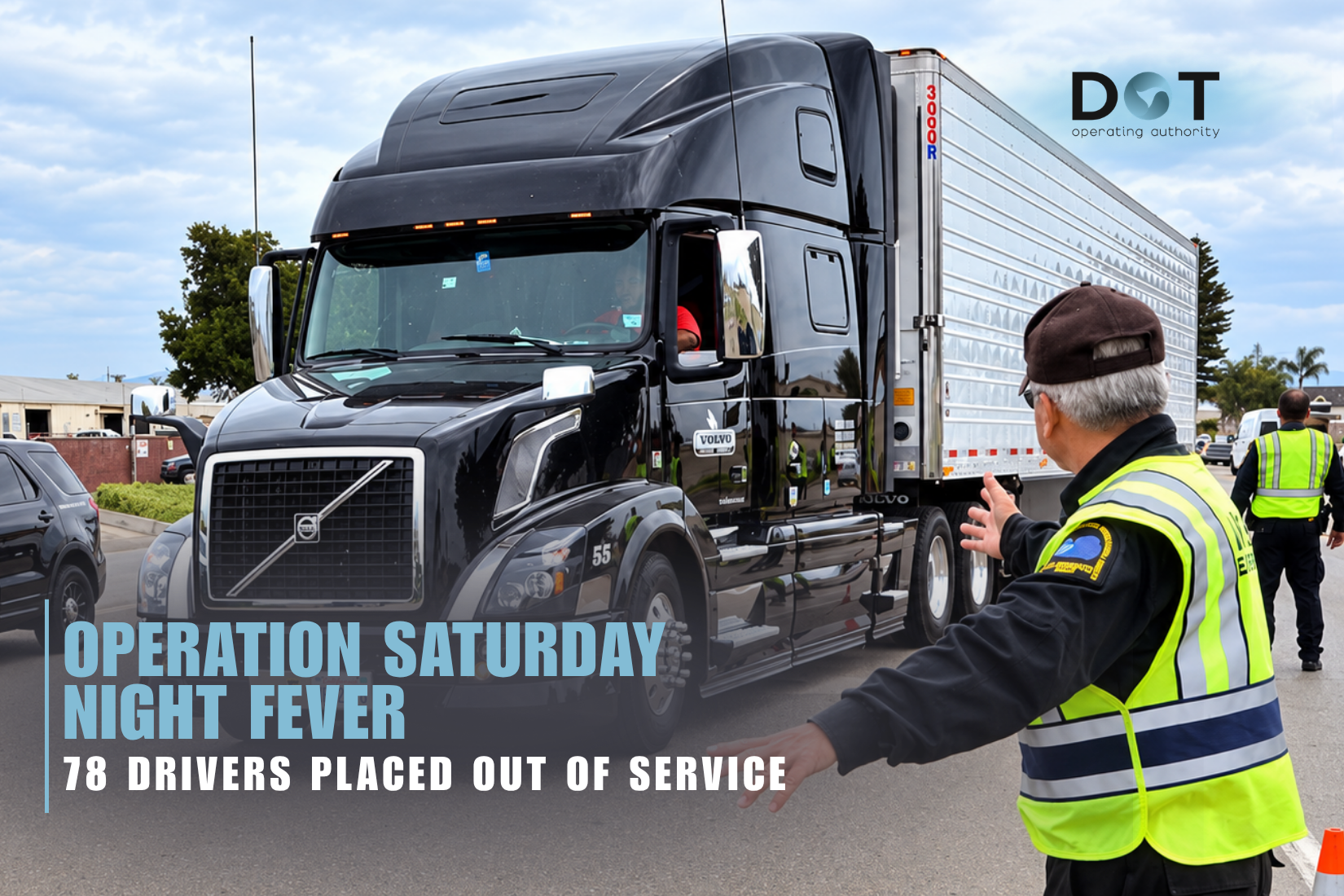
A late-night trucking enforcement sweep across four states ended with dozens of drivers and vehicles pulled off the road. During Operation Saturday Night Fever on September 26, 2026, federal and state officers inspected commercial vehicles across South Carolina, North Carolina, Florida, and Georgia. FMCSA reported 552 inspections, with 78 drivers and 25 vehicles placed out of service. Among the driver violations, 12 involved English Language Proficiency requirements. The multi-state truck enforcement operation focused on commercial vehicle safety along major freight corridors. Inspectors reviewed driver credentials, electronic logging devices, possible fatigue, distracted driving, cargo securement, vehicle safety, and English-language proficiency. Drivers holding non-domiciled CDLs were also included in the inspections. The operation was one of several commercial vehicle enforcement actions conducted across the United States and Canada in recent weeks, but its inspection totals should be kept separate from those other operations.
FMCSA’s Overnight Operation Spanned Four States
The Trucker reported that enforcement included the Interstate 95 corridor and focused on nighttime activity along important freight routes. The operation was designed to identify commercial vehicle safety violations while also looking for potential criminal activity. The overnight timing was intentional. South Carolina State Transport Police Colonel Dwayne Wilson said late evening and early morning periods can allow dangerous driving behavior to go unnoticed. The agency described Operation Saturday Night Fever as a periodic nighttime enforcement effort aimed particularly at high-crash corridors. Georgia officials also emphasized the interstate nature of commercial trucking enforcement, noting that unsafe operations do not stop at state borders. The operation therefore combined federal and state resources rather than functioning as a single-state truck inspection event.
Inspectors Checked Drivers, Vehicles, and Cargo
The FMCSA truck inspection operation was not limited to one type of violation. Inspectors reviewed both driver qualifications and the physical condition and operation of commercial vehicles. Enforcement teams checked credentials, hours-of-service compliance, electronic logging devices, distracted driving, cargo securement, vehicle defects, and English Language Proficiency.
Driver Checks Covered Credentials and Hours of Service
Driver-related inspections included verification of commercial driving credentials. Inspectors also checked hours-of-service compliance for truck drivers and reviewed electronic logging devices, which are used to document driving and duty status for many regulated operations. FMCSA’s release says inspectors checked for fatigue and distracted driving in addition to reviewing ELDs and credentials. English Language Proficiency was another part of the operation. Federal rules require qualifying commercial motor vehicle drivers to meet English-language requirements. Operation Saturday Night Fever also included drivers holding non-domiciled commercial driver’s licenses, although FMCSA did not publish a separate number showing how many of those drivers were placed out of service. That distinction matters. The presence of non-domiciled CDL holders in the inspections should not be interpreted as meaning that all 78 driver out-of-service orders involved non-domiciled licenses.
Vehicle Checks Looked for Defects and Unsecured Cargo
Inspectors also examined commercial vehicles for conditions that could create safety risks. FMCSA identified hazardous vehicles and unsecured cargo among the issues targeted during the operation. Cargo securement can be especially important during interstate freight movement because shifting or unsecured freight can affect vehicle handling or create hazards for other road users. Vehicle-related inspections were separate from driver qualification checks. A driver can be placed out of service for one reason while the truck itself remains serviceable, or a vehicle may be removed from operation because of a safety defect even when the driver remains qualified.
78 Drivers and 25 Vehicles Were Placed Out of Service
The official Operation Saturday Night Fever results were:
- 552 commercial vehicle inspections
- 78 drivers placed out of service
- 25 vehicles placed out of service
- 12 drivers placed out of service for English Language Proficiency violations
FMCSA published those figures on September 30, four days after the operation.
12 Drivers Were Placed Out of Service for ELP Violations
Of the 78 truck drivers placed out of service, FMCSA said 12 were removed from service for English Language Proficiency violations. The operation also inspected drivers holding non-domiciled CDLs, but the agency did not provide a separate out-of-service count for that group. The remaining driver out-of-service orders therefore should not automatically be attributed to language proficiency or non-domiciled CDL status. Inspections covered a wider range of driver-related issues, including credentials, fatigue, electronic logs, and distracted driving.
Inspectors Conducted 552 Inspections
The 552 inspections also resulted in 25 commercial vehicles being placed out of service. FMCSA’s announcement included much larger enforcement figures, but those numbers are not results from Operation Saturday Night Fever. The agency said that since an April 2025 executive order, federal enforcement efforts had placed 31,200 drivers out of service for English-language issues, shut down nearly 10,000 driving schools, and revoked more than 31,000 licenses that DOT described as improperly issued. Those are broader agency figures reported by FMCSA covering enforcement activity beyond the September 26 operation. Keeping those numbers separate is important when evaluating the scale of this specific commercial truck inspection blitz.
Executive Order 14286 Set a Broader Enforcement Context
The federal focus on English Language Proficiency and non-domiciled CDLs predates Operation Saturday Night Fever. President Donald Trump signed Executive Order 14286 on April 28, 2025. The order directed the Department of Transportation and FMCSA to revise enforcement guidance concerning the existing English-language requirement for commercial motor vehicle drivers. It also directed federal officials to take steps toward revising out-of-service criteria so that an English Language Proficiency violation could result in a driver being placed out of service.
A separate section instructed DOT and FMCSA to review non-domiciled CDLs issued by state agencies for unusual patterns or irregularities and evaluate procedures for verifying domestic and international commercial driving credentials. That order provides broader policy context for the current focus on English language proficiency for truck drivers and non-domiciled CDL enforcement. However, the executive order did not specifically direct Operation Saturday Night Fever. The September 26 inspection action was a separate multi-agency enforcement operation.
Separate Enforcement Blitzes Targeted Truck Safety Across North America
Operation Saturday Night Fever was not the only recent commercial vehicle enforcement activity. FreightWaves reviewed a series of separate enforcement actions conducted between mid-September and October 1 across the United States and Canada. Across the operations included in its roundup, authorities reported at least 124 drivers and 226 commercial vehicles or loads placed out of service. Those figures combine multiple unrelated enforcement events and should not be added to or confused with the September 26 operation.
In Illinois, State Police conducted a two-day hazardous-materials enforcement detail on major northern Illinois highways. Officers performed 532 inspections, including 111 involving hazardous materials, and placed 30 drivers and 60 vehicles out of service. In Arizona, state troopers conducted 46 commercial vehicle inspections along Interstate 10 near Quartzsite and Ehrenberg on September 16. Officers reported 170 violations and placed 11 drivers and 13 commercial vehicles out of service. Separate Arizona stops later in September involved tire, licensing, lighting, and oversize-load issues.
What Do Operation Saturday Night Fever Results Mean for Carriers?
Canadian agencies were active as well. A three-day Commercial Vehicle Safety Alliance operation in Strathcona County, Alberta, inspected 192 vehicles and placed 77 commercial vehicles out of service. Inspectors reviewed items including tires, brakes, lighting, cargo securement, HOS records, licenses, and endorsements. Additional operations took place in Saskatchewan and Ontario. Together, these enforcement actions show that recent inspection activity has covered a broad range of issues from driver qualifications and logs to brakes, tires, cargo securement, and distracted driving. They remain separate operations with their own inspection counts and findings.
Operation Saturday Night Fever shows how multi-state truck enforcement can bring several compliance areas under one inspection effort. Driver qualifications, hours-of-service records, vehicle condition, cargo securement, and language-proficiency requirements can all become part of the same roadside review. For carriers, the broader takeaway is preparation. Keeping driver credentials current, maintaining vehicles, reviewing ELD and HOS records, and addressing compliance issues before dispatch can reduce the chance that a routine inspection turns into an out-of-service problem. The operation also fits within a wider enforcement environment in which federal and state agencies are paying closer attention to commercial vehicle safety and driver qualifications. Carriers should therefore follow current FMCSA guidance and make compliance checks part of normal fleet operations rather than waiting for the next inspection blitz.