
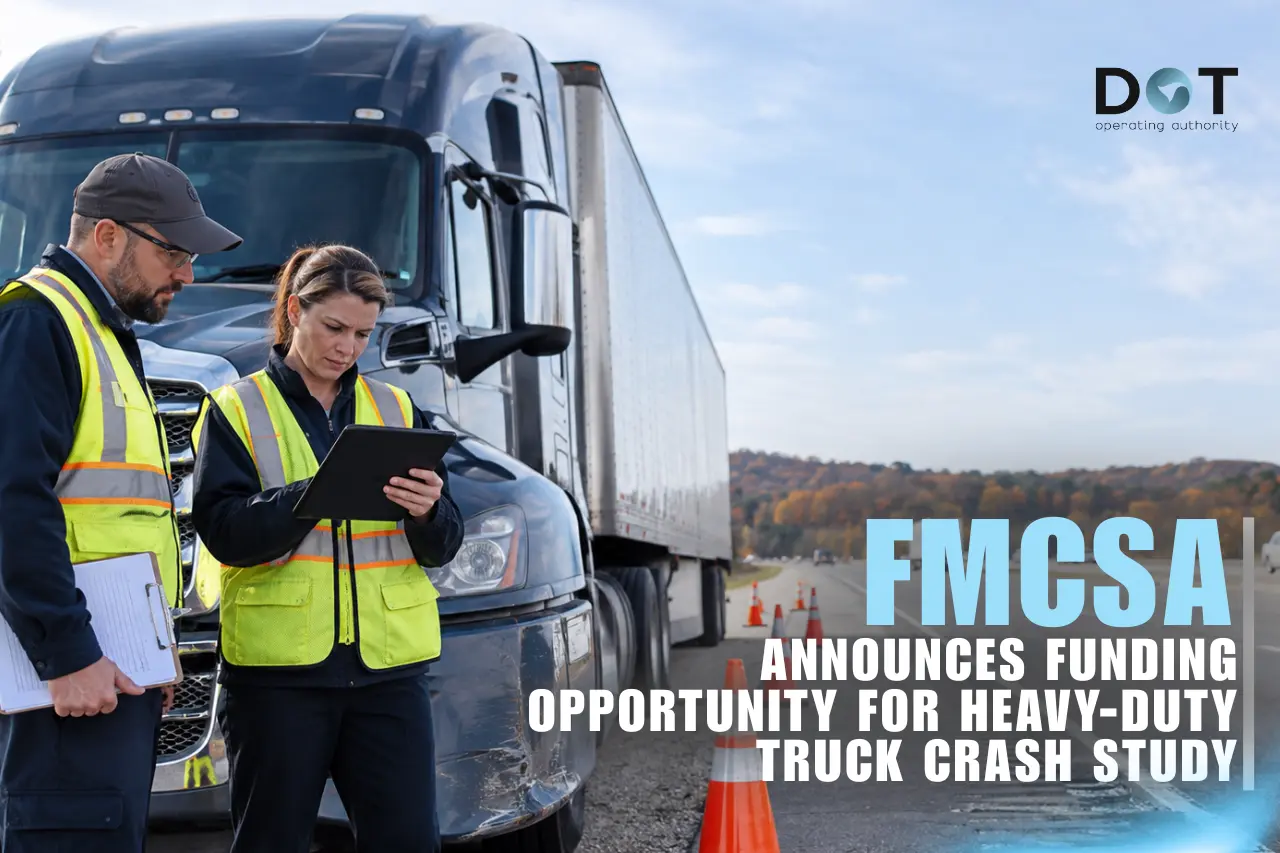
FMCSA is putting new funding behind a large-scale effort to understand why fatal crashes involving heavy-duty trucks happen. On November 3, 2026, the Federal Motor Carrier Safety Administration announced a one-time competitive funding opportunity of up to $7 million for the Crash Causal Factors Program’s Heavy-Duty Truck Study. The FMCSA truck crash study will examine fatal crashes involving Class 7 and 8 trucks and collect detailed information about drivers, vehicles, motor carriers, roadways, and other road users. The money is intended to support the agencies gathering that information, not to compensate trucking companies or provide equipment grants to individual carriers. The study’s goal is to build a stronger evidence base around truck accident causes and help researchers understand which factors contribute to serious crashes.
What Does FMCSA’s $7 Million Funding Opportunity Cover?
FMCSA is offering up to $7 million in competitive funding. This funding is available through the Crash Causal Factors Program Cooperative Agreement Program. No individual award can exceed $500,000, and FMCSA says this is the only funding opportunity planned specifically to support the Heavy-Duty Truck Study’s data-collection period.
Eligible applicants include:
- States selected to participate in the study
- Designated alternate states
- Local law enforcement agencies that meet study participation requirements
For-profit businesses and individual drivers are not eligible recipients. Applications may be submitted through December 28, 2026. FMCSA has also made a prerecorded educational webinar available for prospective applicants. A virtual office-hours session is scheduled for November 12 from 11 a.m. to noon EST, with registration required. Agencies interested in applying should review the full Notice of Funding Opportunity for eligibility rules, application instructions, and submission requirements.
Which Truck Accident Causes Will the FMCSA Study Examine?
The study is designed to look beyond a single explanation for a crash. FMCSA plans to collect and analyze information from a target sample of at least 2,000 fatal crashes involving Class 7 and 8 heavy-duty trucks over two years. The crashes will come from about 30 states identified as key sampling locations for the study. Researchers plan to examine several categories of possible contributing factors. Vehicle-related topics include maintenance, defects, inspection history, vehicle design, and load characteristics.
The study will also consider motor carrier operations, roadway design, weather, road conditions, and work zones. Passenger vehicles, pedestrians, and other road users are also part of the research scope. That distinction matters. A crash involving a heavy-duty truck does not automatically establish that the truck driver caused the collision. The study is intended to examine the circumstances surrounding sampled crashes and identify contributing factors rather than start with a predetermined cause.
What Driver Risk Factors Will the Study Examine?
Driver-related research will include topics such as:
- Driver qualifications
- Fatigue
- Distraction
- Health
- Driver behavior
- Working conditions
Confidential interviews may also help researchers examine scheduling, hiring practices, compensation and benefits, vehicle inspection and maintenance, and the availability of truck stops and rest areas. These subjects are areas of investigation. Their inclusion does not mean FMCSA has already concluded that any one of them is a leading cause of fatal truck crashes. The purpose of the research is to collect enough detailed information to determine which factors are actually associated with the sampled crashes.
How Will the Study Keep Interview Information Confidential?
The Bureau of Transportation Statistics will conduct confidential interviews with people and companies connected to crashes included in the study. Potential participants can include commercial drivers, motor carriers, dispatchers, passenger-vehicle drivers, pedestrians or other non-motorists, and witnesses. The interviews are protected under federal confidentiality rules, including the Confidential Information Protection and Statistical Efficiency Act.
BTS will provide FMCSA with aggregated, anonymized information. FMCSA says it will not receive the complete original interview records or information that would allow an answer to be connected to a specific person, company, or crash. Those protections apply specifically to the confidential interview component. They are separate from police crash reports, post-crash inspections, investigations, and crash reconstructions used for other parts of the research.
How Will the Funding Support Truck Accident Investigation?
The grant money is intended to improve the quality and consistency of data collected after qualifying fatal crashes.
Eligible expenses include:
- Post-crash commercial motor vehicle inspections
- Crash reconstructions
- Post-crash investigations
- Crash data reporting
- Equipment required for study data collection
Qualifying crashes must involve a fatality and at least one Class 7 or 8 heavy-duty truck within a designated study sampling location. These activities provide different pieces of the crash picture. A post-crash vehicle inspection can document defects or violations found after the collision. A reconstruction can examine how the crash occurred. Police reports and investigations can provide information about roadway conditions, vehicles, people involved, and the sequence of events. FMCSA requires applicants to identify performance goals and indicators showing how their proposed work will support the study’s data collection, reporting, inspections, investigations, or reconstructions.
That consistency matters because useful truck accident investigation research depends on more than collecting a large number of reports. The information has to be detailed and comparable enough for researchers to analyze patterns across crashes.
How Could the Study Improve Truck Safety?
The eventual value of the study will depend on what the collected evidence shows. FMCSA says the Crash Causal Factors Program is intended to improve the scientific understanding of commercial-motor-vehicle crashes and provide information that government agencies, motor carriers, researchers, safety groups, and other stakeholders can use when developing commercial vehicle safety strategies. Once data collection and analysis are complete, FMCSA plans to publish a final analytical report and a public database containing anonymized crash data. The agency may also release partial findings before the final report.
When those results appear, context will matter. Readers should look at which crashes were included, how factors were compared, and whether a finding shows an association or provides evidence supporting a causal explanation. The current FMCSA funding announcement does not itself:
- Establish the most common cause of truck crashes
- Determine fault in an individual collision
- Create a new motor carrier operating rule
- Change a carrier’s safety score
Those would be separate questions from the research funding announced in November. For drivers and carriers, the study may eventually provide a more detailed picture of where crash risks arise and which interventions are supported by evidence.
The new FMCSA grants are primarily an investment in better crash information. By funding inspections, reconstructions, investigations, reporting, and related data-collection equipment, FMCSA is giving participating state and local agencies additional resources to document qualifying fatal heavy-duty truck crashes in greater detail. The more important stage comes afterward: analyzing that information carefully enough to distinguish patterns from assumptions.
For carriers and drivers following the FMCSA truck crash study, future findings should be read in that context. A truck’s involvement in a fatal crash does not establish fault, and a factor included in the research does not become a proven cause simply because researchers decided to examine it. The funding announcement begins the data-collection effort. The conclusions about truck safety will come only after the evidence has been gathered and analyzed.