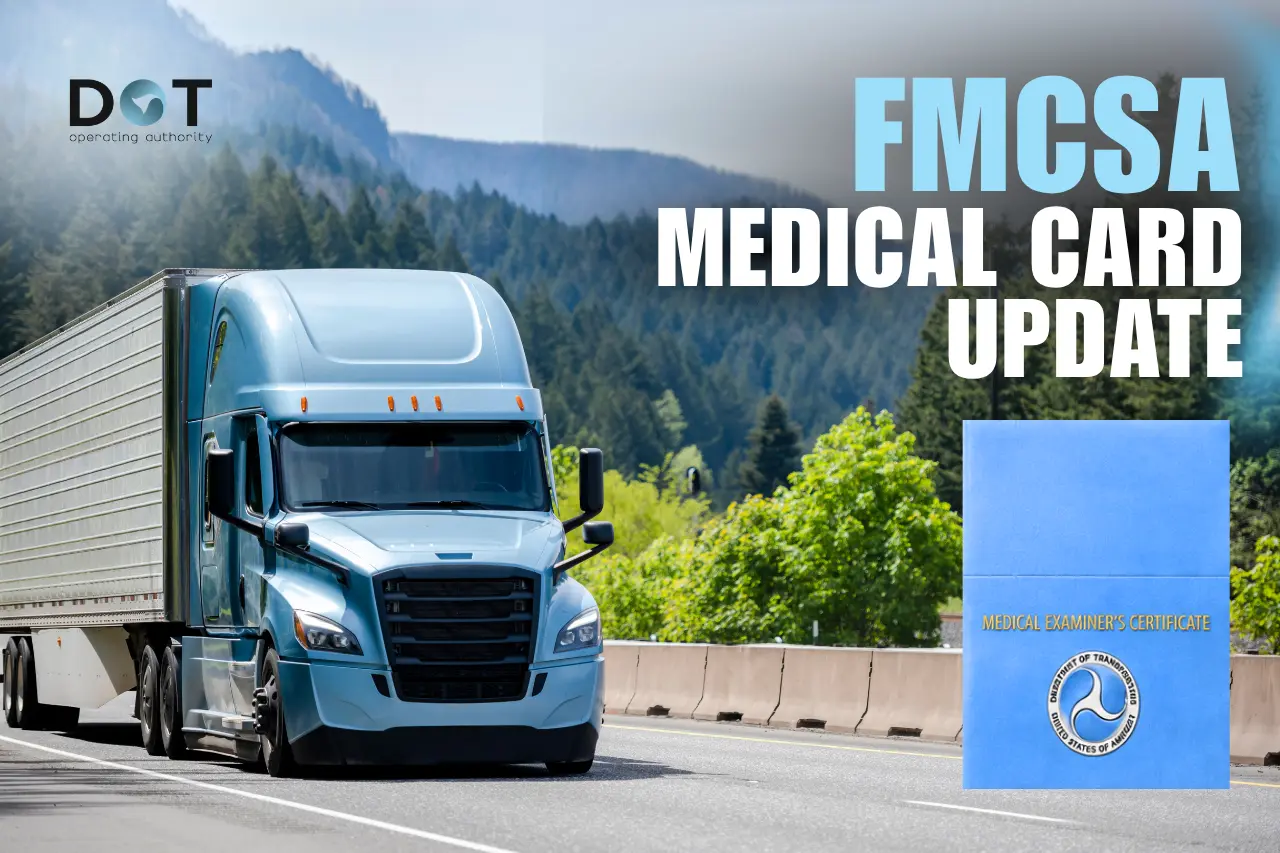
The latest FMCSA medical card update changes how most CDL and commercial learner’s permit holders prove that they are medically certified. As of October 12, 2026, drivers licensed in every state except Alaska and their motor carrier employers can no longer rely on a paper medical examiner’s certificate as proof of medical certification. Alaska remains the only exception because it has not yet implemented the Medical Examiner’s Certification Integration, commonly known as National Registry II or NRII. For most drivers, the system now depends on electronic transmission of medical certification information rather than paper documents. Alaska drivers, however, may continue using a paper certificate for a limited period under a temporary exemption. The key questions are who qualifies for that exception, how long paper proof can be used, and how NRII changes the way medical certification reaches state licensing agencies.
What Changed in the FMCSA Medical Card Update?
The nationwide paper-certificate allowance ended on October 11, 2026. Starting October 12, CDL and CLP holders licensed outside Alaska may no longer rely on paper medical cards as proof of medical certification. Alaska is the only state still operating under an exception because it has not implemented the Medical Examiner’s Certification Integration final rule. That does not mean the underlying medical qualification requirement disappeared. The change is about how proof of medical certification is transmitted and verified.
Under the newer electronic system, CDL and CLP medical certification information is transmitted electronically through FMCSA and state licensing agencies rather than being established through the driver’s paper card.
Who Can Still Use Paper Medical Cards in Alaska?
The Alaska exception is limited to:
- Drivers with a CDL issued by Alaska
- Drivers with a commercial learner’s permit issued by Alaska
- Motor carrier employers relying on those drivers’ medical certification
The exception depends on the state that issued the CDL or CLP, not on where the driver happens to be operating. So, for example, a driver with an Alaska-issued CDL may fall under the exemption even when traveling outside Alaska. A driver licensed in another state does not become eligible simply because the truck enters Alaska.
How Long Can a Paper Medical Examiner’s Certificate Be Used?
Under the Alaska exemption, an eligible driver and employer may rely on a paper medical examiner’s certificate as proof of medical certification for up to 60 days after the certificate was issued. That 60-day period is about proof, not the actual medical validity period. In other words, the paper certificate may be accepted as proof for up to 60 days under the exemption. That does not mean the driver’s medical qualification itself lasts only 60 days. The medical examiner’s certification remains subject to the normal period assigned by the examiner and the applicable federal requirements.
When Does the Alaska Exception End?
The Alaska exemption is effective from October 12, 2026 through October 12, 2027. That one-year exemption period is separate from the 60-day paper-proof window. The distinction is: October 12, 2027 – expiration of Alaska’s temporary exemption. 60 days after an individual MEC is issued – maximum period during which the paper certificate can serve as proof under that exemption.
How Does National Registry II Replace Paper Medical Cards?
The shift away from paper is part of FMCSA’s Medical Examiner’s Certification Integration rule, commonly referred to as National Registry II.
Under NRII, medical examiners transmit medical certification information for CDL and CLP holders electronically. Drivers no longer need to carry and submit an original paper certificate. Overdrive explains that examiners no longer have to issue these drivers an original paper MEC. CDL and CLP holders also no longer need to submit it to their State Driver’s Licensing Agency. This changes the process substantially.
Previously, a driver often had to make sure the paper certificate reached the licensing agency and that the state updated the CDL record. Under NRII, much of that transfer happens electronically.
How Do States Receive CDL Medical Certification Results?
After a medical examination, the certified medical examiner submits the examination result through FMCSA’s National Registry. FMCSA then electronically transmits the medical certification result and applicable medical-variance information to the driver’s State Driver’s Licensing Agency. This electronic exchange is designed to reduce dependence on paper documents moving between the examiner, driver, and state agency. It also means drivers outside Alaska should no longer assume that carrying a paper CDL medical card is the official proof controlling their CDL medical status.
Where Is CDL Medical Certification Recorded?
Once the state receives the information, the State Driver’s Licensing Agency posts the medical certification information to the driver’s Commercial Driver’s License Information System, or CDLIS, motor vehicle record. For CDL and CLP holders outside Alaska’s temporary exception, that electronic record is what reflects the driver’s medical certification status. This is why the transition matters for both drivers and motor carriers. The proof is increasingly tied to the driver’s electronic licensing record rather than a piece of paper kept in the cab or personnel file.
Why Did FMCSA Extend the Paper Medical Card Waiver?
The paper-certificate waiver existed because the transition to NRII did not happen smoothly everywhere at once. In July 2025, FMCSA issued a temporary nationwide waiver allowing CDL holders, CLP holders, and motor carriers to rely on a paper copy of the MEC for up to 15 days after issuance. FMCSA introduced the temporary measure to protect medically qualified drivers from processing delays. Certified medical examiners and state licensing agencies were shifting to electronic transmission. On August 21, 2025, FMCSA extended the allowance from 15 to 60 days after examiners issued the MEC.
The agency aimed to prevent hardship for drivers and employers who could not control those delays. Processing backlogs sometimes prevented the electronic system from promptly displaying valid medical certifications.
FMCSA also recommended during the transition that certified medical examiners continue providing paper MECs in addition to electronically submitting examination results. Those nationwide waivers were temporary transition measures. By October 2026, every state except Alaska had implemented the electronic system, which is why the broad paper-proof allowance could end while Alaska received a state-specific exemption.
Do CDL Drivers Still Need Medical Certification?
Yes. The move away from paper proof does not remove the medical qualification requirement. FMCSA’s Alaska exemption specifically states that it does not change the rule requiring a person to be certified by a medical examiner as physically qualified before operating a commercial motor vehicle when federal medical qualification rules apply. It also does not change the underlying physical qualification standards.
That means drivers still need to:
- Complete the required medical examination
- Be medically certified when federal rules require it
- Maintain valid medical qualification
- Make sure their CDL or CLP record reflects the required medical status
The main change is the proof and reporting process. Outside Alaska, the electronic record now controls rather than the driver’s paper MEC. In Alaska, the temporary exemption allows qualifying drivers and their employers to continue relying on paper proof for up to 60 days after issuance while the state completes the transition.
The FMCSA medical card update marks the end of routine paper-certificate reliance for nearly all CDL and CLP holders. As of October 12, 2026, drivers licensed outside Alaska and their employers can no longer use a paper medical examiner’s certificate as proof of medical certification. Their status is now handled through the electronic National Registry II process and reflected through state licensing records. Alaska remains the temporary exception. Drivers with Alaska-issued CDLs or CLPs and their employers may rely on a paper MEC for up to 60 days after issuance under an exemption that runs through October 12, 2027. What has changed is the reporting and proof system. What has not changed is the requirement for drivers subject to federal medical standards to remain properly medically certified before operating.