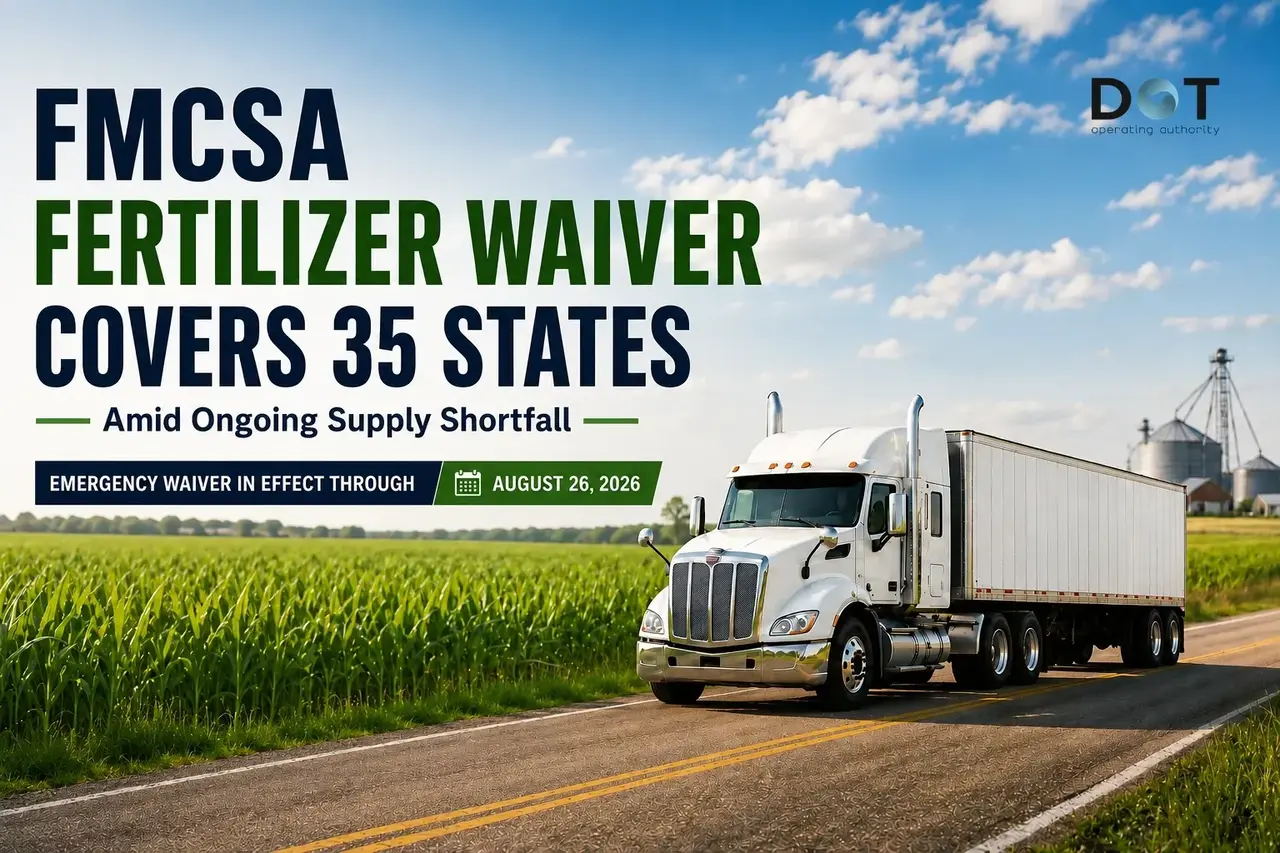
One of the biggest pieces of FMCSA news affecting agricultural transportation this summer arrived on May 26, when the Federal Motor Carrier Safety Administration issued an emergency waiver aimed at helping move fertilizer products across large portions of the country. The temporary relief comes as federal officials continue responding to fertilizer supply challenges affecting commercial farming and ranching operations in 35 states. Under the waiver, eligible drivers transporting fertilizer products can operate under modified hours-of-service (HOS) requirements and are temporarily exempt from certain electronic logging device (ELD) requirements while hauling qualifying loads.
According to federal officials, fertilizer availability remains essential to agricultural productivity, food supply stability, and national security. With planting and growing seasons already underway in many regions, regulators determined that additional transportation flexibility was necessary to help ensure fertilizer reaches farms when it is needed most. The action has quickly become one of the most closely watched developments in FMCSA rule news today, particularly for carriers serving agricultural customers throughout the Midwest, South, and other major farming regions.
FMCSA Issues Emergency Waiver to Address Fertilizer Supply Challenges
The FMCSA emergency declaration was issued after federal agencies identified ongoing fertilizer supply disruptions affecting agricultural producers across multiple states. In announcing the action, FMCSA noted that fertilizer shortages occurring during the spring and summer growing season can create significant challenges for farmers, ranchers, suppliers, and transportation providers. Delays in fertilizer delivery can impact planting schedules, crop health, and overall agricultural productivity.
To help address these concerns, the agency issued the May 26 FMCSA waiver, providing temporary regulatory relief for drivers transporting qualifying fertilizer products used in commercial agriculture. Under the waiver, affected drivers are exempt from the standard federal hours-of-service limits contained in 49 CFR 395.3 while transporting qualifying fertilizer loads. The order also provides temporary relief from the electronic logging device requirement found in 49 CFR 395.8(a)(1)(i). The goal is straightforward: allow carriers greater flexibility to move fertilizer products efficiently during a period of elevated demand while maintaining important safety safeguards. While the waiver provides relief from certain federal regulations, it does not eliminate all safety requirements or compliance obligations.
Which States Are Covered Under the Fertilizer Transportation Waiver?
The fertilizer waiver applies to transportation operations in 35 states:
Alabama, Arkansas, California, Delaware, Florida, Georgia, Idaho, Illinois, Indiana, Iowa, Kansas, Kentucky, Louisiana, Maryland, Michigan, Minnesota, Mississippi, Missouri, Montana, Nebraska, North Carolina, North Dakota, Ohio, Oklahoma, Oregon, Pennsylvania, South Carolina, South Dakota, Tennessee, Texas, Virginia, Washington, West Virginia, Wisconsin, Wyoming.
The waiver covers motor carriers and drivers transporting straight or blended fertilizer products intended for commercial farming and ranching operations. Because fertilizer demand is especially high during planting and crop-growth periods, the waiver is designed to help ensure products continue moving through agricultural supply chains without unnecessary transportation bottlenecks. For many carriers serving agricultural markets, the temporary exemption provides additional operational flexibility during one of the busiest periods of the year.
Safety Conditions Drivers Must Follow Under the FMCSA Waiver
Although the waiver grants relief from certain HOS and ELD requirements, safety remains a central focus. Drivers operating under the waiver cannot drive more than 16 hours within any 24-hour period. The order also requires drivers to take mandatory rest periods. Operators using a sleeper berth must obtain at least six consecutive hours of rest during each 24-hour period. Drivers operating vehicles without a sleeper berth must take at least eight consecutive hours off duty during the same period. Another important requirement involves recordkeeping.
Because qualifying drivers may operate without an electronic logging device, they must maintain paper records of duty status and supporting documentation while operating under the exemption. These records must be retained and made available to enforcement officials if requested. FMCSA also makes clear that motor carriers must allow drivers to immediately stop and rest whenever fatigue becomes a concern. In other words, the waiver provides flexibility, not permission to ignore safe operating practices.
What Motor Carriers Need to Know About Compliance Requirements
Motor carriers should understand that the waiver does not suspend all federal transportation regulations. Several important compliance requirements remain fully in effect. Drivers must continue holding valid commercial driver’s licenses and remain qualified to operate commercial motor vehicles. Any driver subject to an out-of-service order, suspension, or disqualification remains ineligible to operate under the waiver.
Likewise, motor carriers currently under federal out-of-service orders cannot utilize the exemption until those orders have been formally lifted. Carriers must also continue complying with applicable federal and state laws governing fertilizer transportation, vehicle registration requirements, insurance requirements, licensing rules, and agricultural transportation regulations. Accident reporting requirements remain in place as well. FMCSA requires carriers operating under the waiver to report qualifying crashes involving exempted operations within the agency’s required reporting timeframe. While the waiver removes specific regulatory barriers, it does not eliminate the responsibility to maintain proper documentation, records, and operational oversight.
Why Fertilizer Transportation Remains Critical to U.S. Agriculture
The reason behind the waiver becomes clear when looking at the role fertilizer plays in modern agriculture. Fertilizer is essential for crop production across millions of acres of farmland throughout the United States. Disruptions in supply can affect planting schedules, crop yields, operational costs, and food production. Federal officials have emphasized that maintaining access to fertilizer is not simply an agricultural issue. It also affects supply chain stability, food availability, and broader economic activity.
FMCSA noted that federal agencies continue working to strengthen domestic fertilizer production and improve distribution networks across the country. The temporary waiver is one part of a broader effort to help ensure farmers receive the products they need during critical growing periods. The agency also stressed that the waiver has important limitations. The exemption does not apply to the transportation of hazardous materials requiring placarding. Other federal safety regulations remain fully enforceable, and drivers must continue complying with applicable operational requirements not specifically addressed by the waiver. Unless modified, extended, or terminated earlier, the waiver is scheduled to remain in effect through August 26, 2026.
The FMCSA waiver issued on May 26 provides temporary regulatory relief for drivers and carriers transporting fertilizer products across 35 states during a period of ongoing supply challenges. By temporarily easing certain hours-of-service and ELD requirements, federal regulators hope to improve fertilizer movement throughout the agricultural supply chain and help farmers obtain critical products during the growing season. For motor carriers, the waiver creates additional operational flexibility. However, compliance responsibilities have not disappeared. Drivers and carriers must continue meeting key safety standards, maintaining required records, and following applicable federal and state regulations while operating under the exemption.
As fertilizer demand remains high throughout the summer, this latest piece of FMCSA news will likely remain an important development for agricultural carriers, farm suppliers, and trucking companies serving America’s farming communities.