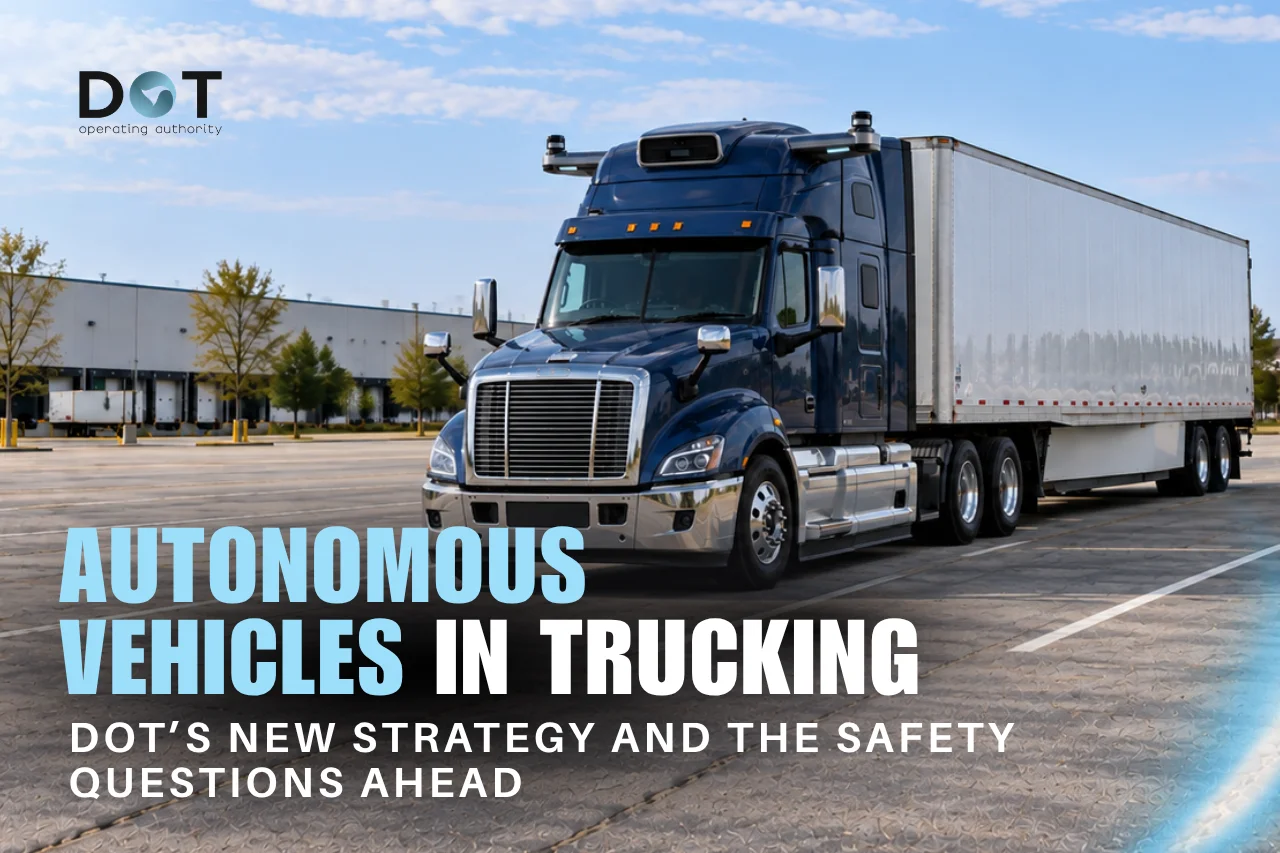
Driverless trucks are no longer just a “someday” transportation story. The U.S. Department of Transportation says automated driving system-equipped trucks are already hauling commercial cargo on some interstate routes. Now DOT wants to create a clearer national framework for what comes next. On September 3, 2026, DOT released its new National Strategy for Automated Vehicles, a roadmap covering fiscal years 2026 through 2030. The strategy aims to encourage broader automated-vehicle deployment while maintaining federal safety oversight, updating regulations written around human drivers, and reducing conflicts between state systems. For autonomous vehicles in trucking, however, the most important part may be what the strategy does not do. It does not suddenly create a new nationwide operating rule for driverless semi-trucks.
Instead, DOT says FMCSA is working on separate regulations governing automated commercial motor vehicles. Those rules, not the strategy document itself, will determine many of the practical requirements carriers eventually have to follow. So the race toward autonomous trucking is accelerating. The rulebook is still catching up.
What Is DOT’s New Automated Vehicle Strategy?
DOT’s strategy is essentially a federal roadmap for how the department intends to approach automated vehicles over the next several years. It lays out four main goals:
- Prioritize safety. DOT says safety oversight should remain central as automated vehicles expand.
- Provide regulatory certainty. The department wants to modernize rules that were written assuming a human driver would always be sitting behind the wheel.
- Promote American innovation. DOT wants automated passenger and freight technologies developed and deployed more widely in the United States.
- Facilitate interoperable corridors. The department wants states and federal agencies to work toward systems that allow automated vehicles to operate more consistently across state lines.
That final point matters especially for trucking. A passenger robotaxi may spend most of its life inside one metropolitan area. A Class 8 truck can cross multiple state lines in a single day. If every state develops substantially different AV operating rules, interstate autonomous trucking becomes much harder to scale. DOT therefore says it wants to convene federal agencies, states, and industry stakeholders to improve cross-state interoperability and digital coordination. But the strategy is a direction of travel, not a finished regulatory map.
How Does DOT Plan to Address Automated Vehicle Safety?
DOT is making a fairly ambitious promise: encourage innovation without treating safety oversight as optional. NHTSA remains responsible for vehicle and equipment safety. According to the new strategy, the agency continues to monitor automated vehicles through crash reporting, defect investigations, recalls, and other enforcement tools. NHTSA is also developing something potentially much more important: minimum performance standards for automated driving system competency. DOT says those standards are intended to establish objective performance requirements for ADS technology operating on public roads. The work is still being developed, so it would be premature to describe those competency standards as already finalized federal requirements. That distinction matters because the safety debate around autonomous vehicles often gets reduced to one question:
Are computers safer than drivers? DOT is optimistic that automation can eventually reduce crashes related to human problems such as fatigue, impairment, and distraction. But the strategy itself also acknowledges that new technology can introduce new and unique safety risks. In other words, replacing human error does not automatically eliminate risk. It changes the type of risk regulators have to manage.
That can include how software responds to unusual road conditions, how sensors interpret an unpredictable environment, what happens during a system failure, and how emergency responders interact with an automated truck that may have no driver in the cab. DOT is already researching that last problem. FMCSA is developing an emergency-response framework specifically for ADS-equipped commercial vehicles so first responders have more consistent guidance when dealing with automated trucks.
What Could the Strategy Mean for Autonomous Trucks?
This is where the broader AV strategy turns into a trucking compliance story. FMCSA, not NHTSA alone, is responsible for regulating the safe operation of commercial motor vehicles, including trucks and buses equipped with automated driving systems. DOT’s strategy says FMCSA is currently working to modernize regulations governing ADS-equipped CMVs. If finalized, those rules could amend parts of the Federal Motor Carrier Safety Regulations to account for trucks where an automated driving system performs tasks historically assigned to a human driver.
The rulemaking is listed under RIN 2126-AC17, Motor Carrier Operation of Automated Driving Systems-Equipped Commercial Motor Vehicles. The Unified Agenda describes potential changes involving areas such as CMV operation, inspection, repair, maintenance, and rules that currently assume a human operator.
That raises some very practical trucking questions.
- Who performs a traditional pre-trip inspection if there is no driver?
- How is cargo securement checked during a trip?
- Who is responsible for ensuring safety-critical software is current?
- How should a driverless truck respond when it breaks down on the shoulder?
- What happens when the vehicle reaches conditions outside the operating environment the automated system was designed to handle?
Earlier FMCSA work has explored exactly these kinds of issues, including operational design domains, inspections, maintenance, cargo securement, and fail-safe operation. This is where AI in trucking stops being a technology story and becomes a compliance story. A self-driving truck still has brakes, tires, cargo, maintenance requirements, roadside interactions, and a motor carrier responsible for its operation. Automation changes who or what is performing some tasks. It does not make commercial vehicle safety regulation disappear.
Why Are Truckers Concerned About the Rollout?
DOT sees automated vehicles as an opportunity. However, truckers’ concerns about autonomous trucks reveal a much more complicated picture. The Owner-Operator Independent Drivers Association, through its Fighting for Truckers campaign, argues that autonomous truck deployment needs stronger federal oversight and greater input from working drivers. OOIDA says policymakers should not rely only on technology developers when deciding how automated trucks share public roads with professional drivers and everyone else. The organization also argues that more safety data should be mandatory rather than voluntary. OOIDA cites survey data saying 86% of Americans are concerned about sharing the road with autonomous trucks. That figure is OOIDA’s reported survey statistic and should be understood as part of the organization’s argument for stronger oversight, not as a DOT finding. That concern exposes the central tension in DOT’s strategy. The federal government wants fewer unnecessary barriers to deployment. Truckers want proof that removing barriers will not also remove safeguards. Public trust may ultimately depend on whether regulators can do both.
What Are the Problems With Autonomous Trucks?
There is no single proven failure that makes autonomous trucking inherently unsafe. There are, however, several unresolved risk categories. One is software failure. Automated trucks depend on complex software to interpret the environment and make driving decisions. Errors can produce unexpected vehicle behavior. Another is sensor performance. Cameras, radar, lidar, GPS, and other systems have limitations. Weather, dirt, unusual road geometry, construction, or other conditions can make the driving environment harder to interpret. Cybersecurity is another concern because increasingly connected vehicles create different types of system risk than conventional trucks. Then there is the problem of unusual situations.
Human drivers routinely deal with things that are difficult to predict in advance: debris in the road, emergency responders giving hand signals, temporary lane markings, stopped vehicles, unusual construction zones, animals, damaged infrastructure, and other drivers doing things they absolutely were not supposed to do. A truck-accident law firm that has argued for greater caution around autonomous trucking highlights software malfunctions, sensor limitations, unpredictable system behavior, emergency intervention, and liability among the major unresolved concerns. Those are the firm’s stated safety concerns rather than federal findings.
Liability becomes especially complicated when the traditional driver disappears. If an automated semi crashes, responsibility could potentially involve the motor carrier, ADS developer, vehicle manufacturer, maintenance provider, software system, or some combination of parties depending on the circumstances. That is one reason simply asking, “How many self-driving vehicles crash?” does not answer the larger safety question. Raw crash counts do not tell regulators how many miles automated vehicles traveled, where they operated, under what conditions, what automation level was active, or whether the automated system caused the crash. Reliability has to be evaluated against exposure and operating conditions, not headlines alone.
DOT’s new automated-vehicle strategy makes one thing clear: the federal government wants automation to move forward. That includes freight. The department wants stronger federal coordination, fewer unnecessary regulatory barriers, new automated-driving performance standards, and a transportation system where automated vehicles can operate more consistently across state lines. But the strategy also acknowledges that new technology introduces new safety risks. For trucking, the real test will therefore come from FMCSA. Its forthcoming regulatory work will have to translate rules written around human drivers into something that still protects the public when software is doing the driving. That means answering questions about inspections, maintenance, emergency response, operating conditions, carrier responsibility, and enforcement while giving the industry enough certainty to deploy the technology. The debate over autonomous vehicles in trucking is no longer really about whether self-driving trucks will appear on U.S. highways. Some already have. The harder question is whether regulation, transparency, and public trust can keep pace with them.