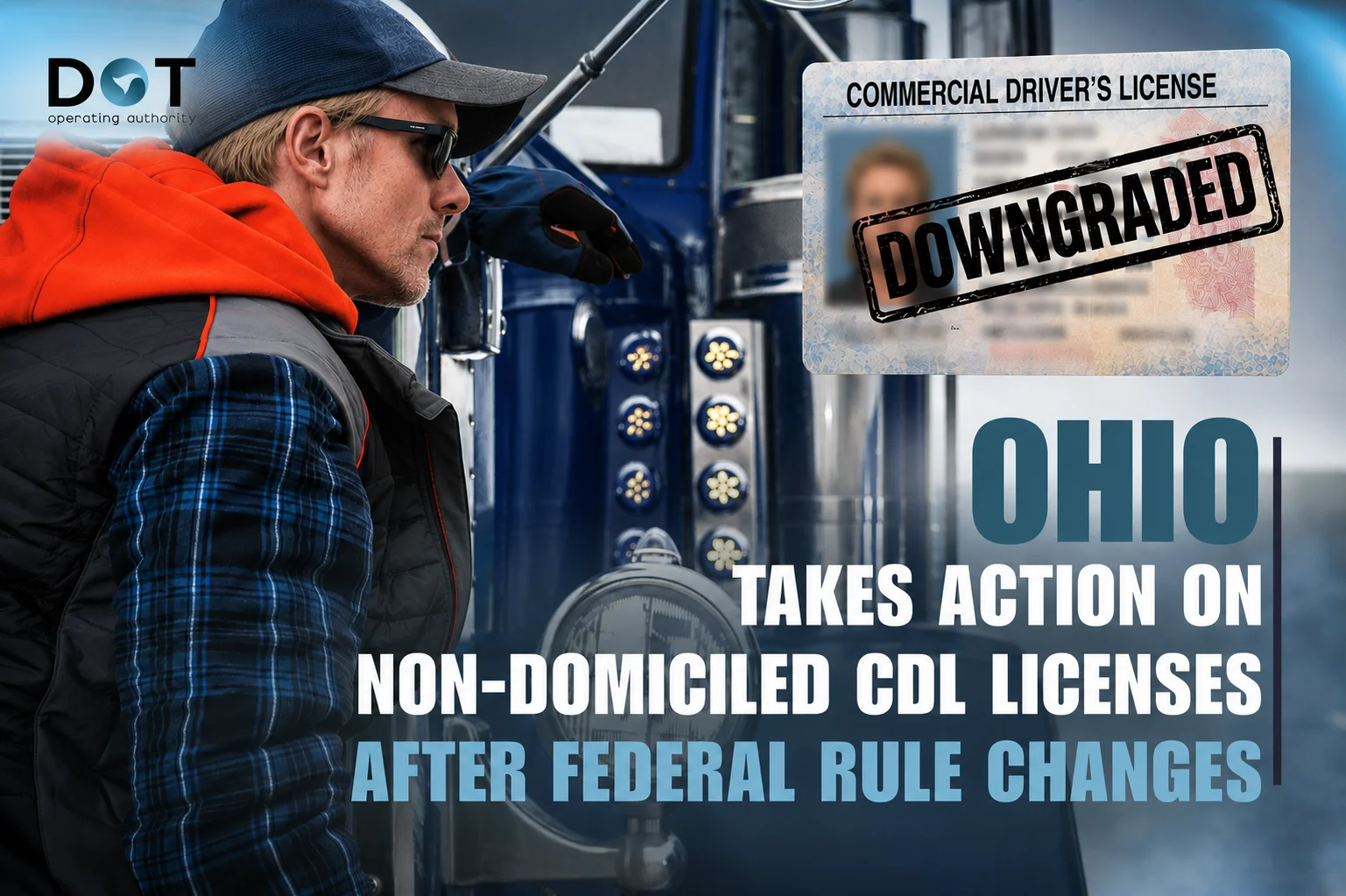
Ohio has downgraded approximately 1,200 non-domiciled CDLs as state officials review commercial driver’s licenses under updated federal standards. The Ohio Bureau of Motor Vehicles (BMV) began examining roughly 5,000 non-domiciled CDL records after recent federal rule changes and guidance from the Federal Motor Carrier Safety Administration (FMCSA). Drivers are receiving notices based on whether the documentation used to obtain their CDL meets current federal requirements.
The review has become one of the most significant state-level responses to recent FMCSA enforcement efforts. According to reports, Ohio officials are evaluating each license individually and determining whether drivers remain eligible to hold commercial driving privileges under the updated rules. For many drivers following FMCSA news today, the Ohio review may offer a preview of how other states handle similar compliance concerns.
What Are Non-Domiciled CDLs?
Many drivers are asking, what are non-domiciled CDLs? A non-domiciled CDL is a commercial driver’s license issued to certain individuals who are not legally domiciled in the state issuing the license. Federal regulations allow states to issue these licenses under specific circumstances when applicants meet federal testing, documentation, and eligibility requirements.
The issue has gained attention because FMCSA recently tightened standards governing who qualifies for a non-domiciled CDL and what documents states must verify before issuing or renewing one. As a result, states such as Ohio have begun reviewing existing records to determine whether previously issued licenses remain compliant with current federal expectations.
What Happened With Non-Domiciled CDLs in Ohio?
Ohio’s review of non-domiciled CDLs began after FMCSA updated its standards and encouraged states to examine existing records for compliance. Federal guidance has emphasized that states should identify licenses that may not have met documentation requirements at the time they were issued and take corrective action when necessary.
When Ohio determines that a driver no longer qualifies under the applicable standards, the commercial driving privilege is downgraded. Instead of holding a CDL, the individual receives a standard Class D passenger driver’s license.
This distinction is important. Once downgraded, the driver can no longer use that OH CDL license to operate a commercial motor vehicle. The change affects employment eligibility for commercial driving positions and may require additional action from the driver if they wish to challenge the decision.
The review has become a major topic in both state transportation circles and broader FMCSA news coverage because thousands of licenses remain under review.
Why Ohio Is Downgrading Some CDL Licenses
Ohio officials say the review focuses on whether the original documentation used to obtain a CDL satisfies current federal requirements. The state has generally divided affected drivers into two categories. The first group includes drivers whose documentation appears sufficient under the standards that applied when their CDL was issued. These drivers may keep their CDL until the credential expires. However, Ohio has indicated that it does not plan to renew those non-domiciled CDLs after expiration. The second group includes drivers whose documentation does not meet current federal standards. These individuals receive a CDL downgrade notice informing them that their commercial driving privileges will be downgraded unless they successfully challenge the determination. According to reports, drivers in this category generally have 30 days from the notice date before the downgrade takes effect. This process is part of Ohio’s effort to align its licensing system with federal requirements and avoid compliance issues identified through FMCSA oversight.
What Drivers Can Do After Receiving a CDL Downgrade Notice
Receiving a CDL downgrade notice does not necessarily mean the process is over. Affected drivers may request a hearing through the Ohio Bureau of Motor Vehicles and present additional documentation that could demonstrate eligibility. The purpose of the hearing is to allow the driver an opportunity to dispute the downgrade or provide records that were not previously available during the review.
Examples of documents that may be considered include:
- An unexpired Employment Authorization Document (EAD) issued by USCIS that was valid on the driver’s most recent CDL or commercial learner’s permit issuance date.
- An unexpired foreign passport together with an unexpired USCIS I-94 form, both of which were valid on the driver’s most recent CDL or CLP issuance date.
Drivers should carefully review any notice they receive and follow the instructions provided by Ohio BMV. Because every case may involve different facts and documentation, affected individuals should ensure they understand the deadlines and requirements associated with their hearing request.
Can You Get CDL Back After Downgrade in Ohio?
Can I get my CDL back after downgrading in Ohio? Possibly. A driver may be able to challenge the downgrade by requesting a hearing and submitting documentation that demonstrates eligibility under federal and Ohio licensing requirements. Whether a CDL can be restored depends on the driver’s ability to prove that the credential was properly issued or that qualifying documentation exists to support continued eligibility. Simply requesting a hearing does not automatically reverse the downgrade. Drivers who receive a downgrade notice should review the available appeal procedures and gather any supporting documents as quickly as possible because response deadlines can be limited.
What This Means for Ohio Trucking and FMCSA Enforcement
The Ohio review extends beyond individual drivers and reflects a broader shift in federal oversight. Ohio officials have stated that the state is no longer issuing or renewing non-domiciled CDLs under the previous framework. The state also does not plan to resume issuing those credentials unless future circumstances allow for compliance with federal standards. This development aligns with wider FMCSA news involving state reviews of commercial licensing practices. FMCSA has encouraged states to audit non-domiciled CDL records and address licenses that may not comply with federal regulations. Federal guidance specifically recommends reviewing existing credentials and taking corrective action when necessary.
For the trucking industry, the changes could affect driver availability, fleet hiring strategies, and compliance procedures. Carriers that employ drivers with non-domiciled CDL credentials may need to monitor license status carefully as additional reviews occur. As more states evaluate their records, many industry observers expect similar actions to appear in future FMCSA news today reports.
Ohio’s review of non-domiciled CDLs has already resulted in approximately 1,200 license downgrades, and thousands of additional records remain under review. The state’s actions follow updated FMCSA standards and broader efforts to ensure commercial driver’s licenses comply with federal requirements.
Drivers who receive a notice from Ohio BMV should read it carefully, respond within the required timeframe, and gather any eligible supporting documents if they intend to challenge a downgrade. As FMCSA enforcement efforts continue, Ohio’s review may serve as an important example of how states are responding to changing CDL eligibility standards.