
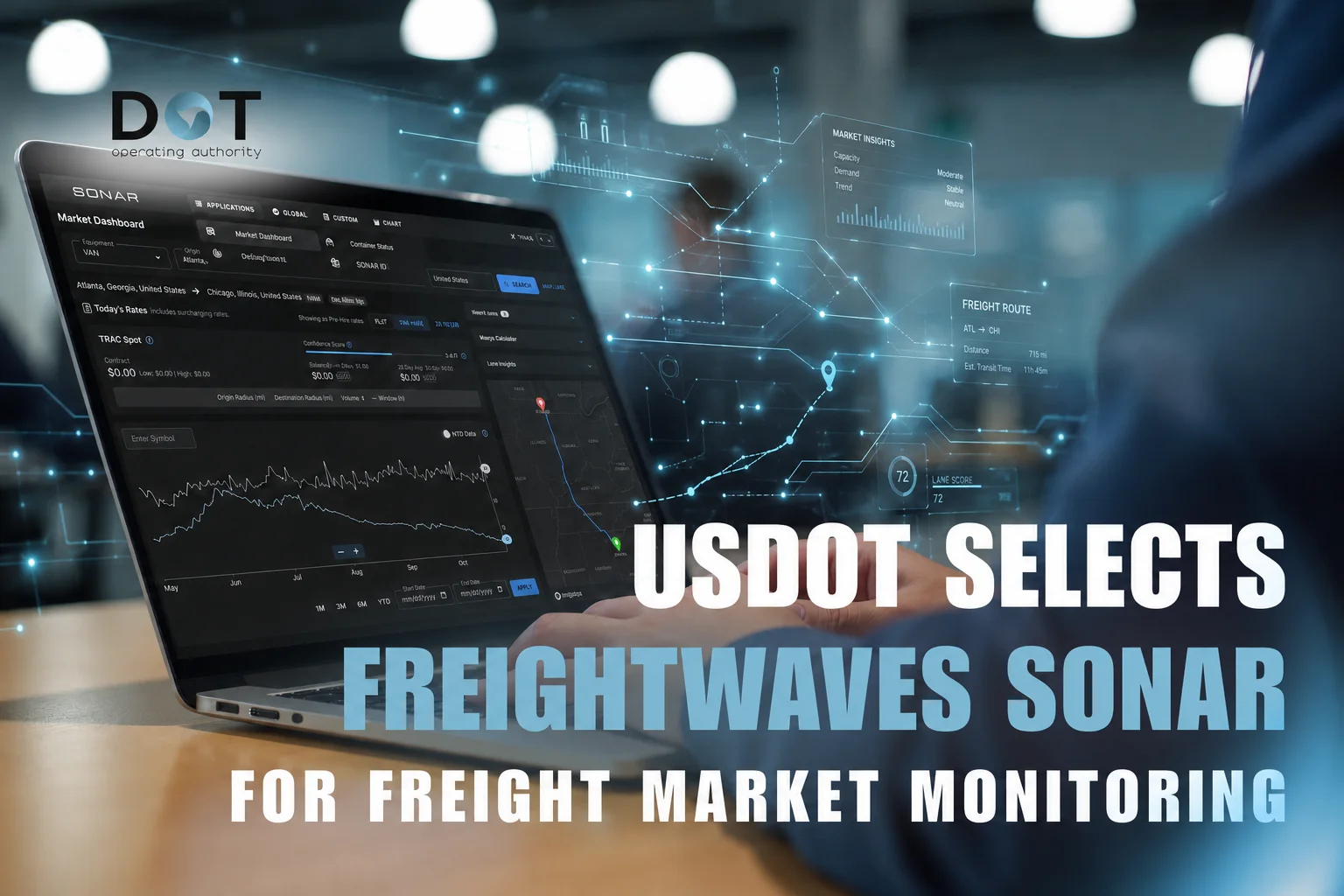
The freight market leaves clues everywhere. A slowdown in imports shows up in trucking demand. Spot rates start moving before many economic reports catch up. Tender volumes rise or fall long before most people realize something has changed. That’s one reason freight data has become so valuable not just for carriers, brokers, and shippers, but for policymakers as well. This week, FreightWaves announced that the U.S. Department of Transportation has signed on as a customer of FreightWaves SONAR, giving federal transportation officials access to the company’s high-frequency freight market data. On the surface, it sounds like a straightforward technology contract. In reality, it says something bigger about where transportation oversight is heading. Government agencies have traditionally relied on reports that arrive weeks or months after events occur. Freight markets don’t move that slowly. A lane can tighten in a matter of days. Capacity can disappear almost overnight. By the time a traditional report lands on someone’s desk, the market may already be telling a different story. Access to real-time freight intelligence gives USDOT a chance to see those changes while they’re happening.
USDOT Awards Freight Data Contract to FreightWaves SONAR
The new freight data contract gives USDOT access to FreightWaves SONAR, a platform already used across much of the transportation industry to track freight demand, capacity, pricing, and network activity. For years, brokers, carriers, analysts, and shippers have relied on SONAR to get a clearer picture of what’s happening in the market beyond their own operations. Now the federal government will be looking at many of those same signals. That’s notable because transportation agencies often face a common challenge: they have access to enormous amounts of information, but much of it arrives after the fact. Historical data still matters. Nobody is replacing official reports or economic surveys.
But adding high-frequency market intelligence fills a gap that has become increasingly obvious over the last several years. If freight demand suddenly drops in a region, if capacity tightens around a major port, or if pricing starts moving in unusual ways, those signals can appear in freight data long before they’re reflected in traditional reporting systems. For anyone who follows DOT trucking news, the agreement feels like another step toward a more data-driven approach to transportation oversight.
Real-Time Freight Intelligence Expands USDOT’s Market Visibility
Ask almost anyone in logistics what keeps them awake at night, and uncertainty usually ends up somewhere near the top of the list. Markets shift quickly. Weather interrupts networks. Consumer demand changes. Fuel prices move. Freight reacts to all of it. That’s where real-time visibility becomes useful. Instead of looking backward, agencies can see what freight markets are doing right now. Tender volumes can reveal changes in shipping activity. Rejection rates can point to capacity constraints. Spot market movements often tell their own story about supply and demand. None of those metrics provide all the answers on their own. Together, though, they paint a much clearer picture of what’s happening across the transportation network. And when you’re responsible for monitoring a freight system that moves billions of dollars’ worth of goods every day, that kind of visibility matters.
Supply Chain Resilience Remains a Key Transportation Priority
A few years ago, supply chains became dinner-table conversation. Most people had never thought much about ports, warehouses, trucking capacity, or inventory management. Then products started disappearing from shelves, and delivery times stretched from days into months. The lesson was pretty simple: supply chains work best when nobody notices them. When they break, everyone notices. Federal transportation officials have spent much of the past several years focused on supply chain monitoring and resilience. The goal isn’t just moving freight efficiently. It’s understanding where problems are developing before they become larger disruptions. That’s one reason supply chain monitoring tools have become increasingly important across both the private and public sectors. Better information doesn’t eliminate disruptions. It does make them easier to identify, track, and respond to.
Federal Data Modernization Efforts Gain Momentum
The FreightWaves agreement also fits into a larger trend that has been quietly reshaping transportation policy. More agencies are moving away from relying exclusively on static reports and toward systems that provide a more current view of market conditions. That shift isn’t unique to transportation. It’s happening across government and business alike. People expect information faster than they did a decade ago. Decision-makers do too. For USDOT, incorporating freight intelligence into existing transportation analysis tools is another sign that data modernization remains a priority. The transportation industry itself has already gone through this evolution. Carriers and brokers increasingly make decisions using dashboards, analytics platforms, and real-time reporting. Government agencies appear to be moving in the same direction.
New Data Access Could Shape Freight Policy and Industry Oversight
The most interesting part of this partnership may be what happens next. Access to better information often changes how decisions get made. Real-time freight intelligence could help support infrastructure planning, improve market analysis, identify transportation bottlenecks, and strengthen broader industry oversight. It may also provide additional context when policymakers evaluate freight trends, economic conditions, and network performance. Exactly how the data will be used remains to be seen. But it’s hard to ignore the larger signal here. Transportation policy has always depended on data. The difference now is the speed at which that data arrives.
The partnership between FreightWaves SONAR and USDOT isn’t just another technology announcement. It’s a reflection of how transportation analysis is changing. Freight markets move quickly. Supply chains are more complex than ever. Waiting months for information isn’t always enough when conditions can shift in a matter of days.
For people who follow freight market news, the agreement highlights something that’s becoming increasingly clear across the industry: real-time visibility is no longer a competitive advantage reserved for private companies. It’s becoming an important tool for transportation planning, supply chain monitoring, and public-sector decision-making as well. And as freight data becomes more accessible and more sophisticated, its influence on transportation policy will likely continue to grow.