
Drivers will soon be able to legally travel a little faster on several stretches of rural interstate in Missouri. The Missouri Department of Transportation announced on October 21, 2026, that the Missouri speed limit will increase from 70 mph to 75 mph on eight selected segments of I-29, I-35, I-49, and I-55. Together, the corridors cover about 325 miles of rural interstate.
The change follows a new state law allowing a 75 mph maximum on rural interstates and freeways. But the higher limit does not take effect simply because the routes have been selected. MoDOT says drivers must continue following the currently posted speed limits until crews install the new 75 mph signs. For truck drivers, the affected routes include several important freight corridors connecting Missouri with Iowa and Arkansas.
Missouri Raises Limits to 75 MPH on Eight Rural Interstate Corridors
MoDOT selected eight sections of four interstate highways after reviewing eligible rural routes across the state.
The new 75 mph limits will appear on portions of:
- I-29
- I-35
- I-49
- I-55
Together, the eight stretches total approximately 325 miles. Many are close to Missouri’s borders with Iowa or Arkansas, while four separate I-55 segments run through rural southeast Missouri. The announcement represents the first group of corridors selected under Missouri’s new authority to allow speeds of up to 75 mph on rural interstates and freeways. MoDOT did not simply raise the limit across every rural interstate. Instead, the department evaluated individual corridors and selected only those where it concluded that the higher posted limit could be introduced while considering traffic, roadway design, crash history, and other safety factors.
I-55 Gets the Most New 75 MPH Mileage, Followed by I-29, I-49 and I-35
I-55 receives the largest amount of roadway approved for the Missouri speed limit increase.
I-29: 64 Miles
The new limit will apply from Exit 56 in Andrew County to approximately 2.5 miles south of the Iowa border. That section covers about 64 miles.
I-35: 55 Miles
On I-35, the 75 mph section runs from the northern Cameron city limit to approximately four miles south of the Iowa border. The segment covers approximately 55 miles.
I-49: Two Segments Totaling 69 Miles
I-49 receives two separate increases:
- Arkansas border to Exit 24: approximately 24 miles
- Exit 56 to just south of Exit 101 in Nevada: approximately 45 miles
Together, those sections total approximately 69 miles.
I-55: Four Segments Totaling 137 Miles
The largest share of the change is on I-55. MoDOT identified four stretches:
- Arkansas border to mile marker 16.6 – approximately 17 miles
- Mile marker 19.8 to 64.9 – approximately 45 miles
- Mile marker 70.5 to 86.6 – approximately 16 miles
- Mile marker 106.4 to 164.9 at the Jefferson County line approximately 59 miles
That gives I-55 roughly 137 miles of newly approved 75 mph roadway.
| Interstate | Number of segments | Approximate mileage approved for 75 mph |
| I-29 | 1 | 64 miles |
| I-35 | 1 | 55 miles |
| I-49 | 2 | 69 miles |
| I-55 | 4 | 137 miles |
| Total | 8 | 325 miles |
For drivers looking for the map, MoDOT has also published an official speed limit map that shows the approximate locations of the selected corridors.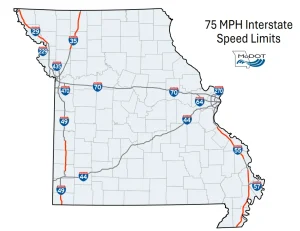
New State Law SB 1408 Cleared the Way for Higher Limits
The change comes from Senate Bill 1408. The legislation increased Missouri’s maximum speed limit on rural interstate highways and freeways from 70 mph to 75 mph. The Missouri Senate’s bill records confirm that Gov. Mike Kehoe signed SB 1408 on July 13, 2026. Before the change, Missouri law generally set the maximum at 70 mph for these roads.
The new law does not require every eligible highway to immediately receive a 75 mph sign. MoDOT retains authority to evaluate individual roadways and recommend appropriate posted limits. The law took effect on August 28, 2026, after which MoDOT continued studying eligible locations before announcing the first eight segments in October. In other words, Missouri lawmakers passed a bill raising rural highway speed limits, but the actual posted limit still depends on MoDOT’s roadway-by-roadway evaluation.
Crash History, Truck Traffic and Border States Shaped MoDOT’s Picks
MoDOT says it conducted a detailed review before selecting the eight corridors.The department considered:
- Current traffic volume
- Truck traffic volume
- Current speed data
- Crash history
- Terrain
- Road design
- Existing safety countermeasures
- Speed limits in neighboring states near state lines
- Active construction
Truck traffic was therefore specifically part of the evaluation. Border conditions also mattered. Several selected routes approach Iowa or Arkansas, where drivers may transition between different state speed-limit systems. That helps explain why many of the approved stretches run close to state lines rather than covering entire Missouri interstates.
MoDOT also excluded some roads from immediate consideration because of construction. Earlier in the evaluation process, the department said I-70 would not receive an increase during its major reconstruction and expansion, with the corridor to be reconsidered after that work is complete.
New Signs Go Up in Fall 2026
The legal maximum may now be 75 mph on qualifying rural interstates and freeways, but drivers should not accelerate to 75 simply because they enter one of the selected corridors. The posted sign still controls. MoDOT says crews will update the signs on the selected stretches during fall 2026. Until those signs are changed, motorists must continue following the speed limit currently posted on the highway. That distinction is particularly important during the transition period because different sections of the same interstate can have different posted limits. Drivers should therefore rely on roadside signs rather than assuming that all rural portions of I-29, I-35, I-49, or I-55 are now 75 mph.
MoDOT Director Warns Highways Were Not Built for 80+ MPH Traffic
MoDOT paired the announcement with a clear safety warning. Director Ed Hassinger said the department’s decision followed a detailed study designed to identify locations where traffic could move more efficiently at higher speeds without sacrificing safety. He emphasized that the decision was not made lightly. He also stressed the meaning of the word limit.
Hassinger warned that Missouri highways were not designed for traffic traveling above 80 mph and said drivers have significantly less time to react as speed increases. His message to motorists was to buckle up, stay alert, drive sober, and follow the posted limit.
The Missouri State Highway Patrol delivered a similar message. Colonel Michael Turner said drivers should reduce speed when road, traffic, or weather conditions require it even where the posted maximum rises to 75 mph. So the speed limit in Missouri remains a maximum not a requirement to maintain that speed regardless of conditions.
MoDOT Could Roll Limits Back to 70 MPH if Crashes Rise
The 75 mph designation is not necessarily permanent. MoDOT says it will continue monitoring crash data on the affected highways after the new limits take effect. If the results show a safety concern, the department may reduce an affected corridor back to 70 mph. That gives the department a way to reconsider a corridor based on what happens after the higher limit is actually introduced.
The state has already acknowledged the broader safety tradeoff involved in higher speeds. During legislative consideration of SB 1408, MoDOT told the Missouri Highways and Transportation Commission that higher speeds can increase crash severity even while reducing travel time. The selected corridors will therefore continue to be evaluated rather than treated as permanently fixed at 75 mph.
Faster Limits Hit Key Freight Routes on I-55, I-29 and I-35
The change is particularly relevant to commercial drivers because several of the selected interstates are significant freight routes. I-55 provides an important north-south connection through southeast Missouri toward Arkansas and the broader Mississippi River transportation network. I-29 connects northwest Missouri and the Kansas City/St. Joseph region toward Iowa. I-35 is another major north-south freight route connecting Missouri with Iowa and markets farther north. Truck Driver News notes that these corridors carry significant commercial traffic and that I-49 also serves freight moving between western Missouri, northwest Arkansas, and central U.S. markets.
However, neither MoDOT’s announcement nor the sources reviewed here identify a separate 75 mph truck speed limit for these selected segments. The announcement concerns the posted limits on the identified highway sections generally. Truck drivers must still follow all other applicable Missouri rules of the road, vehicle-specific restrictions, work-zone limits, weather-related adjustments, and any lower posted limits encountered along the route.
The practical impact for freight operations is therefore less about a guaranteed reduction in trip time and more about understanding where the posted maximum is changing.
Missouri’s new 75 mph authority does not turn every rural interstate into a higher-speed corridor.
Instead, MoDOT selected eight segments totaling approximately 325 miles after reviewing traffic patterns, truck volumes, road design, crashes, terrain, construction, and nearby state limits. For drivers, the most important rule during the transition is simple: follow the sign that is actually posted. The higher limit begins only as MoDOT installs the new signage on the selected sections. Once in place, the department will continue monitoring crash performance and can return a corridor to 70 mph if safety conditions warrant it. For truckers running I-55, I-29, I-35, or I-49, the change is worth watching, but route planning should still be based on the posted limit for each segment, not the statewide 75 mph maximum.