
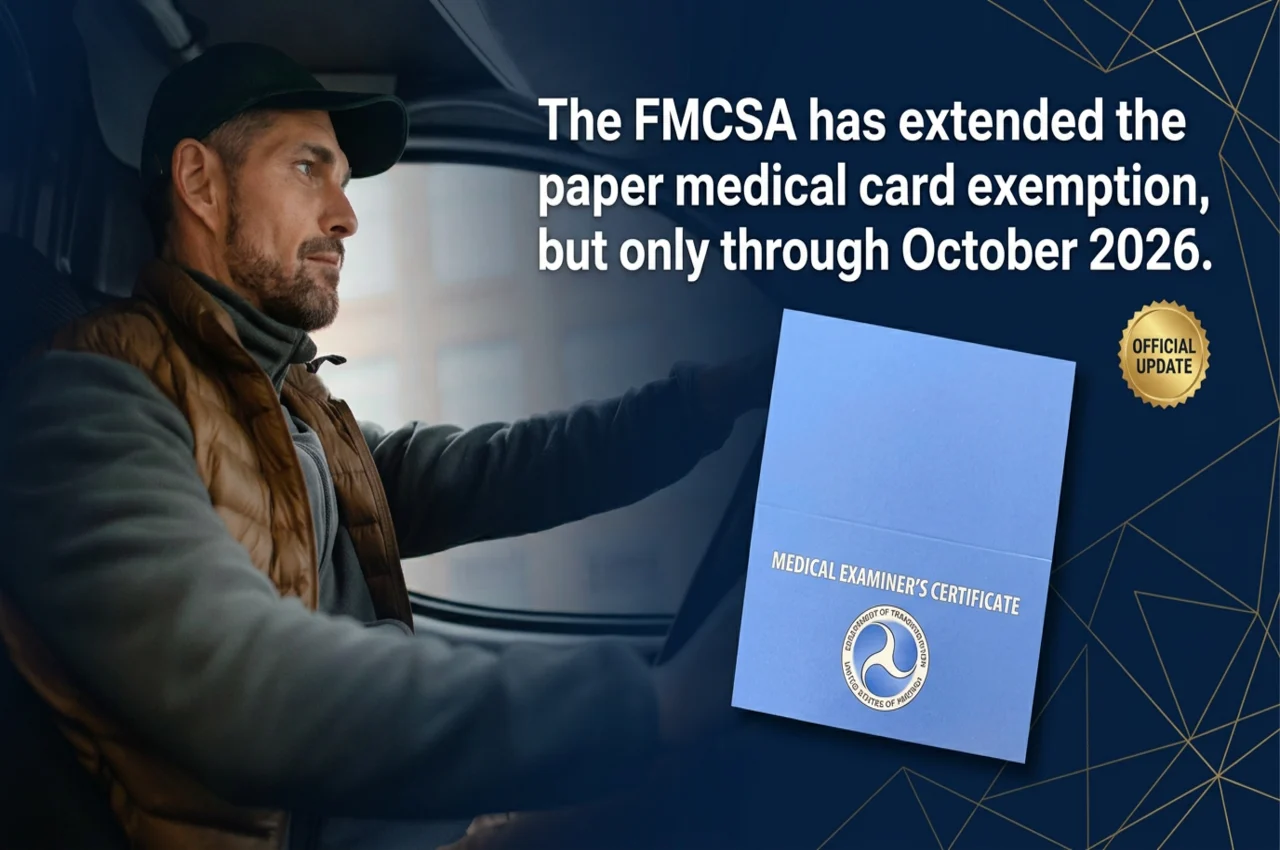
The commercial trucking industry is once again adjusting to a major compliance update from the Federal Motor Carrier Safety Administration (FMCSA). The agency has officially extended the temporary allowance for paper Medical Examiner’s Certificates (MECs), giving drivers and carriers additional time during the ongoing shift to a fully electronic medical certification system. This exemption is effective from April 11 through October 11, 2026, and continues to allow CDL holders, CLP holders, and motor carriers to rely on paper medical cards for up to 60 days from the date of issuance.
In simple terms paper DOT physical certificates are still valid but only as part of a limited transition window tied to FMCSA’s digital modernization efforts.
What the New FMCSA Exemption Allows
The FMCSA exemption provides temporary regulatory relief while the agency continues rolling out its Medical Examiner’s Certification Integration system. Here’s what it means for drivers and carriers:
- Paper Medical Examiner’s Certificates (MECs) remain valid for up to 60 days
after issuance - Applies to both CDL holders and CLP holders operating interstate
- Motor carriers may continue accepting paper MECs during compliance verification
- This replaces the previous shorter 15-day acceptance window
This exemption is not a permanent rule change. It is strictly a six-month transition measure designed to support the full implementation of electronic reporting systems. According to FMCSA guidance and supporting industry updates, no additional nationwide extensions beyond October 2026 are expected.
How the process works during the transition
Under the updated system:
- Certified medical examiners complete a DOT physical exam
- Results are submitted electronically to FMCSA
- FMCSA transmits certification data to state driver licensing agencies
- Medical status is reflected in the CDLIS database
However, because system syncing is not always immediate, the paper MEC remains a critical backup document during roadside inspections and carrier audits. This document is especially important for interstate CDL operations, where delays between systems can temporarily create mismatched records.
Why FMCSA Extended the Paper Medical Card Rule
The exemption is directly tied to the rollout of the Medical Examiner’s Certification Integration (NRII system), a long-planned modernization effort designed to eliminate paper-based medical certification. The goal of the system is simple: replace physical cards with real-time digital verification. But implementation has been far from smooth.
Originally scheduled for launch in 2018, the system faced repeated delays first moving to 2021, then 2025. When it finally began rollout in mid-2025, operational issues immediately surfaced, forcing FMCSA to introduce temporary waivers.
State-level rollout challenges
One of the biggest issues is uneven adoption across states. As of early 2026, several states had not fully integrated into the NRII system.
- Alaska
- California
- Kentucky
- Louisiana
- New Hampshire
This creates a serious compliance gap: even when a driver completes a valid DOT physical exam, their certification may not appear correctly in electronic systems like CDLIS.
Why paper MECs still matter
During this transition period, paper MECs remain essential because:
- Electronic updates may be delayed
- State systems may not sync in real time
- Roadside enforcement still relies on backup documentation
This is why FMCSA extended the exemption to prevent drivers from being penalized for system-related delays outside their control.
What Happens After October 11, 2026
Once the exemption expires, FMCSA is expected to fully transition away from paper-based medical certification.
This means:
- Paper MECs may no longer serve as primary proof of medical fitness
- Enforcement will rely heavily on electronic verification systems
- CDL status will be validated through real-time database checks
After this date, compliance will depend on accurate system integration between:
- Certified medical examiners
- FMCSA databases
- State driver licensing agencies
- CDLIS records
What this means for drivers and carriers
For CDL holders and interstate CLP operators, the stakes are higher than ever. If electronic records are missing, outdated or incorrectly transmitted drivers could be placed out of service, even if they physically hold a valid paper certificate from a recent DOT physical. This marks a major shift in enforcement strategy from document-based compliance to system-based verification.
Problems With NRII System Implementation
Despite its long-term benefits, the NRII rollout has faced persistent technical and administrative challenges. Common issues include:
- Delayed transmission of exam results
- Missing or expired records in CDLIS
- State-level system incompatibility
- Data sync failures between agencies
Even in states with full integration, drivers have reported cases where valid medical certifications appeared incorrectly in federal databases. These ongoing issues are a major reason FMCSA continues to maintain temporary paper certificate allowances through 2026.
Safety and fraud concerns behind electronic verification
One of the driving forces behind this transition is improving safety and reducing fraud in the DOT physical system. Historically, investigations have uncovered cases where medical examiners issued certifications without proper evaluations. Under paper-only systems, these issues were difficult to track.
The electronic system improves oversight by:
- Time-stamping every medical exam submission
- Linking exams to certified medical examiners
- Creating a centralized audit trail
- Enabling real-time verification by enforcement officers
While the rollout is still stabilizing, FMCSA continues to support the long-term shift because it strengthens compliance accuracy and reduces fraudulent certification risks.
The FMCSA extension allowing paper Medical Examiner’s Certificates through October 11, 2026 is best understood as a final transition buffer, not a policy reversal. It supports the ongoing implementation of the Medical Examiner’s Certification Integration system, which is designed to fully modernize how DOT physical results are processed and verified.
For CDL holders, CLP holders, and motor carriers, this is a critical compliance window. Paper MECs are still valid, but only temporarily, and only within strict limits. The key takeaway is clear: This is the last phase of the transition toward a fully electronic medical certification system. Carriers and drivers who begin aligning their compliance processes now tracking DOT physical renewals, verifying electronic records, and monitoring FMCSA updates will be far better prepared when paper documentation is fully phased out after October 2026.