
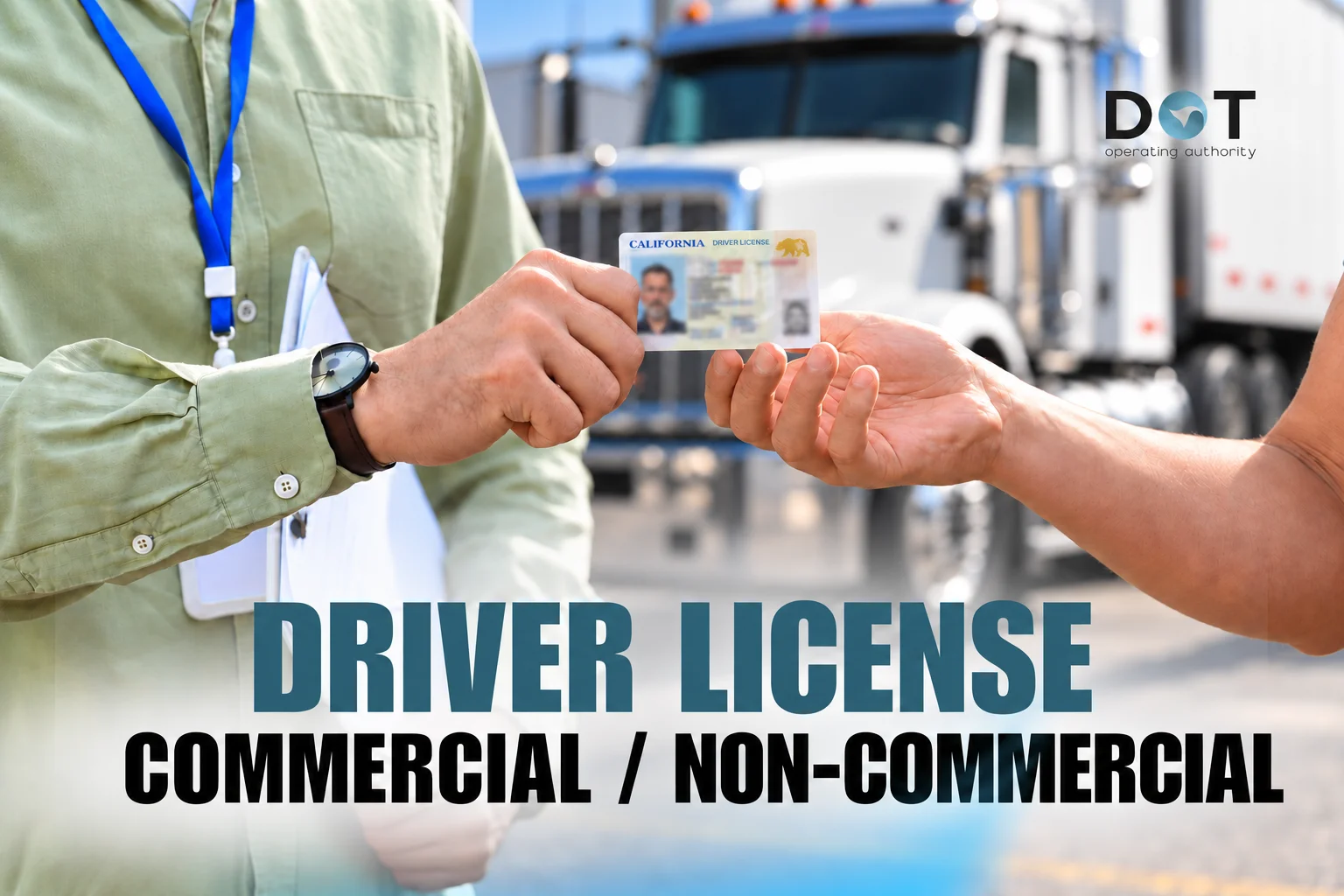
A bigger truck does not always mean you need a CDL. Getting paid to drive does not automatically mean you need one either. The real commercial vs noncommercial license difference comes down largely to the vehicle you operate, its weight and configuration, how many passengers it is designed to carry, and whether it transports certain hazardous materials. That is why a delivery driver in a light van might use a regular driver’s license, while someone operating a large straight truck or tractor-trailer generally needs a commercial driver’s license.
Federal rules establish minimum CDL standards, but states actually issue the licenses and can impose additional requirements. So before choosing between a CDL vs. non-CDL license, it helps to understand what each license covers and which vehicles trigger federal CDL requirements.
What Is a Commercial Driver’s License?
CDL stands for Commercial Driver’s License. Under federal regulations, a CDL is a license issued by a state or other jurisdiction that authorizes a qualified person to operate a class of commercial motor vehicle.
Getting one involves more than the standard process for a passenger-car license. FMCSA explains that operating a commercial motor vehicle requires a higher level of knowledge, skill, experience, and physical ability. CDL applicants must pass knowledge and skills tests appropriate for the type of vehicle they intend to drive. States issue CDLs under federal minimum standards. A driver also generally cannot hold licenses from multiple states at the same time.
There are three federal CDL classes:
- Class A
- Class B
- Class C
The correct class depends on the vehicle’s weight, configuration, passengers, and cargo.
What Is a Non-Commercial Driver’s License?
A non-commercial driver’s license is the type of state-issued license generally used for ordinary passenger vehicles and other vehicles that do not require a CDL.
Federal regulations define a non-CDL broadly as another type of motor-vehicle license, such as an automobile driver’s license, chauffeur’s license, or motorcycle license.
For most people, this means the license used to drive cars, SUVs, pickup trucks, and other vehicles that stay below CDL thresholds. However, license names differ from state to state. That creates an especially confusing issue with non-CDL Class C licenses. Some states call their standard passenger license a “Class C.” Federal CDL regulations also use Class C CDL to describe certain commercial passenger and hazardous-material vehicles. Those are not the same license. Whenever you see “Class C,” check whether the source is talking about a state’s regular driver’s license or a federal Class C CDL.
What Is the Difference Between a Commercial and Non-Commercial License?
The biggest difference is what the license authorizes you to drive.
| Comparison point | Commercial driver’s license | Non-commercial driver’s license |
| Primary purpose | Operating vehicles that meet CDL criteria | Operating passenger and other non-CDL vehicles |
| Vehicle limits | Based on weight, configuration, passengers, and cargo | Generally applies below CDL thresholds |
| Testing | CDL-specific knowledge and skills tests | Standard state knowledge and road tests |
| Training | ELDT applies to certain first-time CDL applicants and endorsements | State driver education rules apply |
| Medical requirements | Federal or state requirements may apply depending on operation | State driver education rules apply |
| Endorsements | May require H, N, P, S, T, or X endorsements | CDL endorsements generally do not apply |
| Regulation | Federal minimum standards plus state rules | Primarily state licensing rules |
A CDL is still a driver’s license. CDL holders generally do not maintain a second regular license simply to drive their personal car. Their CDL is their state-issued driver’s license and generally also permits them to operate ordinary non-commercial vehicles, subject to state rules.
Which Vehicles Require a CDL?
One of the biggest misconceptions about commercial driving is that using a vehicle for business automatically makes a CDL necessary. It does not. Federal CDL requirements focus on specific commercial motor vehicle categories. Under 49 CFR §383.5, they include the following:
- Combination vehicles: A combination with a GCWR or actual gross combination weight of at least 26,001 pounds, when the towed unit has a GVWR or actual weight of more than 10,000 pounds.
- Heavy single vehicles: A single vehicle with a GVWR or actual gross vehicle weight of at least 26,001 pounds.
- Passenger vehicles: Vehicles designed to transport 16 or more people, including the driver.
- Certain hazardous-material vehicles: Vehicles transporting hazardous materials that require placards, or specified quantities of select agents or toxins.
That is the difference between a vehicle being used commercially and a vehicle specifically requiring a CDL.Someone might deliver packages in a light van, drive a smaller work truck, or perform another paid driving job without meeting federal CDL thresholds. Other licensing, insurance, or operating rules can still apply. Federal exemptions and state-specific requirements can also change the answer in particular situations.
What Are the Differences Between CDL Classes A, B, and C?
The three CDL classes help match the driver’s license to the type of commercial vehicle being operated.
Class A CDL
A Class A CDL generally applies to qualifying combination vehicles with a GCWR or gross combination weight of at least 26,001 pounds when the towed unit exceeds 10,000 pounds. Tractor-trailers are the most familiar example. Class A can also cover other heavy truck-and-trailer combinations that meet the federal weight criteria.
Class B CDL
A Class B CDL generally applies to a single vehicle weighing at least 26,001 pounds or such a vehicle towing a unit that does not exceed 10,000 pounds. Examples can include straight trucks, certain large buses, and some dump trucks. The trailer distinction is important. If the combination and trailer cross the Class A thresholds, a Class B license may no longer be sufficient.
Class C CDL
A federal Class C CDL covers a vehicle that does not meet Class A or Class B definitions but is either designed to carry at least 16 occupants, including the driver, or transports certain regulated hazardous materials or select agents and toxins. Again, this should not be confused with a state’s ordinary non-CDL Class C license. Same letter. Very different driving privileges.
How Do CDL and Non-CDL Testing Requirements Compare?
Getting a standard driver’s license generally involves meeting your state’s age and eligibility requirements and completing applicable vision, knowledge, and road testing. Getting a CDL adds several commercial-specific steps. FMCSA advises applicants to begin with their state’s CDL manual because states handle the licensing process and may add requirements beyond federal minimums.
A typical CDL path includes:
- Meet federal and state eligibility requirements.
- Apply through your state licensing agency.
- Pass the required knowledge tests and obtain a Commercial Learner’s Permit, or CLP.
- Complete Entry-Level Driver Training when required.
- Hold the CLP for the required period before skills testing.
- Pass the vehicle inspection, basic controls, and road portions of the CDL skills test.
- Receive the appropriate CDL class and endorsements.
FMCSA currently requires Entry-Level Driver Training, or ELDT, for people seeking a Class A or Class B CDL for the first time, upgrading from Class B to Class A, or obtaining their first passenger, school bus, or hazardous-material endorsement. Training must come from a provider listed on FMCSA’s Training Provider Registry. Medical requirements also need careful wording. Not every CDL holder follows identical medical-certification rules. Drivers classified as non-excepted interstate generally must meet federal medical qualification standards. Intrastate drivers follow the requirements established by their state, while certain excepted operations are treated differently.
When Are CDL Endorsements or Restrictions Required?
Having the correct CDL class may still not be enough for a particular job. Drivers operating specialized vehicles may need additional CDL endorsements.
Federal endorsements include:
- T: Double or triple trailers
- P: Passenger vehicles
- N: Tank vehicles
- H: Hazardous materials
- S: School buses
- X: Combined tank and hazardous-material endorsement
Some endorsements require only a knowledge test, while passenger and school-bus endorsements also involve skills testing. Restrictions work in the opposite direction. They limit what a CDL holder is authorized to operate. For example, taking the skills test in an automatic-transmission vehicle can result in an E restriction, which prevents the driver from operating a CMV with a manual transmission. Air-brake and tractor-trailer restrictions can also apply depending on the test vehicle and equipment used. That is why drivers should think about the actual vehicle and job before choosing a test vehicle or applying for endorsements.
How Can You Determine Which License You Need?
Ignore the job title for a moment. Whether an employer calls you a “commercial driver,” “delivery driver,” or “truck driver” does not by itself tell you which license is required. Instead, check the vehicle and operation. Start with the GVWR, GVW, GCWR, and trailer weight or rating. Then determine how many passengers the vehicle is designed to transport and whether the cargo requires hazardous-material placards.
You should also identify whether you will operate in interstate or intrastate commerce and whether a federal exemption applies. Finally, confirm the answer with your state driver licensing agency. FMCSA establishes federal CDL standards, but the states issue licenses and can have additional classifications, restrictions, or requirements. This is particularly important if you are researching commercial vs. passenger driver’s license requirements or a non-CDL Class C license because state terminology can differ significantly.
The central commercial vs. noncommercial license distinction is not simply whether someone gets paid to drive. A regular non-commercial license generally covers ordinary passenger vehicles and other vehicles that remain outside CDL requirements. A CDL becomes necessary when a commercial motor vehicle meets specific federal weight, passenger, or hazardous-material criteria.
Class A generally covers qualifying heavy combinations. Class B covers qualifying heavy single vehicles and certain combinations with lighter trailers. Class C covers certain passenger and hazardous-material vehicles that do not meet the Class A or B definitions. The simplest rule is not to guess from the vehicle’s appearance or your job title. Check the truck’s ratings and actual weights, trailer, passenger capacity, cargo, and type of operation. Then verify the current requirements with your state licensing agency before getting behind the wheel. A vehicle can be used for business without requiring a CDL. But once it crosses the applicable CDL threshold, a regular driver’s license is no longer enough.