
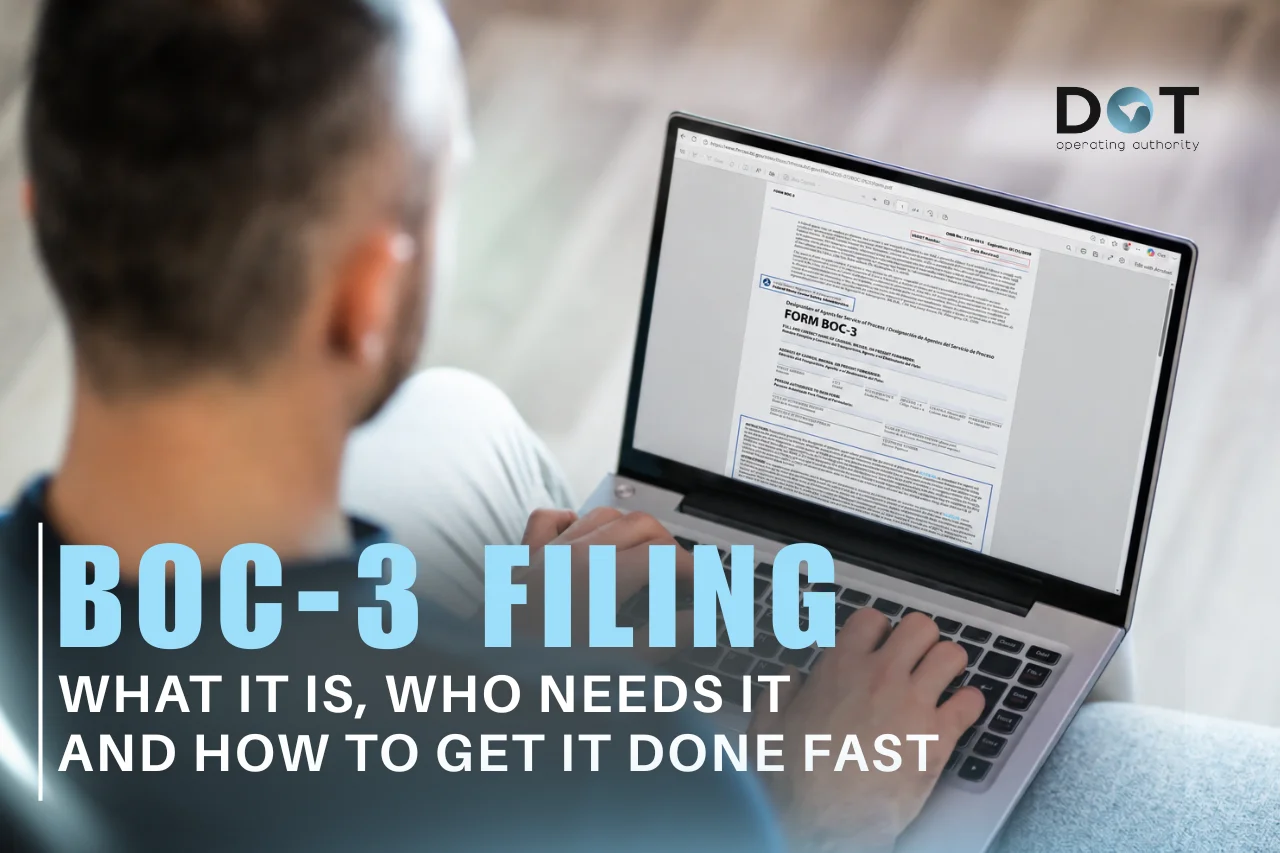
Getting an MC number is not the end of the FMCSA operating-authority process. For many motor carriers, brokers, and freight forwarders, another required piece is BOC-3 filing. Form BOC-3 designates process agents who can receive legal documents on behalf of the transportation business. It is a separate requirement from a USDOT number, operating authority application, and insurance or financial-responsibility filing. FMCSA states that applicable applicants must have their process-agent designation and required financial-responsibility filings in place before operating authority can be granted.
Understanding what BOC-3 does is important because it is easy to mistake the form for another registration number. It is not another authority. Instead, it helps establish where legal process can be delivered if a proceeding involves the carrier, broker, or freight forwarder.
What Is BOC-3 Filing?
Form BOC-3 is formally called the Designation of Agent for Service of Process. In simple terms, the form identifies the people or companies authorized to receive court papers and other formal legal process for a transportation business. The current temporary rule in 49 CFR §366.2T provides that only one completed current Form BOC-3 may be on file. It must cover the states for which process-agent designations are required, and a copy must be retained at the carrier’s or broker’s principal place of business. Many companies use a blanket process-agent company instead of arranging individual agents separately. Blanket companies maintain networks of process agents in multiple states and can make the necessary designations for the applicant. FMCSA maintains a list of registered blanket companies for this purpose.
What Does “Service of Process” Mean?
Service of process means formally delivering legal documents to a person or business involved in a legal proceeding. Those documents can include court papers, complaints, summonses, claims, or other official notices. FMCSA describes a process agent as a representative upon whom court papers may be served in a proceeding brought against a motor carrier, broker, or freight forwarder. The process agent’s role is to receive those documents on behalf of the business. That does not mean the BOC-3 agent automatically acts as the company’s attorney, represents the company in court, or resolves the underlying legal dispute. Receiving legal process and providing legal representation are separate functions.
Is BOC-3 the Same as a USDOT or MC Number?
No. These are three different pieces of the federal registration system. A USDOT number identifies the company in FMCSA’s safety and registration systems. An MC number, or another operating-authority docket number where applicable, relates to the company’s federal operating authority. A BOC-3 filing designates process agents. Filing BOC-3 does not grant operating authority by itself. FMCSA explains that after the applicable vetting process, an applicant must still meet additional requirements such as BOC-3 and proof of insurance or another required financial-responsibility filing before FMCSA grants operating authority. So seeing an MC number assigned to a company does not necessarily mean that company’s authority is already active.
Who Needs a BOC-3 Filing?
The question is not simply, “Do you have a truck?” BOC-3 requirements are tied primarily to the type of FMCSA registration or operating authority the business needs. Under the currently operative process-agent framework, motor carriers and brokers subject to Part 366 must make required process-agent designations. FMCSA’s operating-authority guidance also requires applicable freight-forwarder applicants to maintain BOC-3 information. In practical terms, the requirement commonly affects:
For-hire interstate motor carriers requiring operating authority
Freight brokers
Freight forwarders subject to FMCSA operating-authority requirements
However, holding a USDOT number alone does not automatically mean a company needs BOC-3.
FMCSA’s current process-agent guidance notes that, until all Unified Registration System provisions are implemented, the motor-carrier requirement applies to for-hire carriers rather than every motor carrier simply because it has a USDOT number.
Do Motor Carriers, Brokers and Freight Forwarders Need It?
A for-hire motor carrier applying for federal operating authority generally needs a valid BOC-3 designation. Brokers also need process-agent designations as part of their FMCSA registration requirements. Under the current rule, brokers designate agents in the states where they maintain offices or write contracts. Freight forwarders seeking applicable FMCSA authority are also subject to process-agent requirements in the operating-authority system. FMCSA’s policy on invalid BOC-3 filings specifically addresses motor carriers, brokers, and freight forwarders and requires a valid designation to maintain active authority.
The requirement therefore depends more on what the company does and what federal registration it needs than on whether the company owns trucks.
Do Intrastate Carriers Need BOC-3?
Not necessarily. A carrier operating entirely within one state may not need federal operating authority at all, depending on its operation, cargo, and applicable federal exemptions. If the company does not need FMCSA operating authority, the federal BOC-3 requirement associated with that authority may not apply. State requirements are a separate question. An intrastate carrier may still be subject to state permits, registration, insurance, or process-agent requirements even when federal operating authority is not required. That is why an intrastate company should not file BOC-3 simply because another trucking company has one. The first question should be whether the operation actually requires the applicable FMCSA registration.
When Is BOC-3 Filing Required?
BOC-3 is normally addressed during the federal operating-authority process. Current 49 CFR §365.109T requires applicable operating-authority applicants to submit Form BOC-3 within the specified period after notice of their application is published in the FMCSA Register. The rule currently provides a 20-day period for the BOC-3 and applicable financial-responsibility filings.
More importantly from an applicant’s perspective, FMCSA will not grant applicable operating authority until the required BOC-3 and financial-responsibility requirements are satisfied. That means receiving an MC number should not be confused with receiving active authority.
The authority can remain pending while FMCSA waits for required supporting filings.
Can You File Your Own BOC-3?
For most motor carriers, no. FMCSA’s current Form BOC-3 page states that only a process agent can file Form BOC-3 on behalf of a carrier. There is an important exception: a broker or freight-forwarder applicant without commercial motor vehicles may file the BOC-3 on its own behalf. This distinction matters because search results often oversimplify the question “Can I file my own BOC-3?” into a universal yes or no. For a motor carrier, the filing is generally handled by the process agent or blanket process-agent company.
Is BOC-3 Needed for Authority Reinstatement?
Yes, when the operating authority being reinstated requires a process-agent designation. FMCSA states that a carrier, broker, or freight forwarder requesting reinstatement must have the applicable minimum financial-responsibility filings and a Designation of Process Agent, Form BOC-3, on file. If the old BOC-3 designation is still valid, a new designation may not necessarily be required solely because reinstatement is requested. But if the previous process-agent relationship has ended or the designation is no longer valid, the company needs to correct the BOC-3 situation before the authority can remain properly supported.
Does a BOC-3 Expire or Need to Be Updated?
One of the most common questions is: Do you need to file BOC-3 every year? Generally, no. BOC-3 is not an annual renewal like UCR or certain annual credentials. The current rule says a process-agent designation is canceled or changed by making a new designation. It does not establish a routine annual expiration date for the form. The important requirement is that the designation remains current and valid.
A new BOC-3 may become necessary when:
The company changes its process agent or blanket company.
The existing process-agent relationship ends.
An agent is no longer available to accept service.
Changes to the company’s operating-authority information require an amended designation.
FMCSA identifies the existing designation as invalid.
A company name change is one example where timing matters. FMCSA’s current operating-authority guidance states that after issuance of a re-entitlement letter for certain name changes, an amended BOC-3 and updated insurance filings must be submitted within 30 days.
For other address or contact changes, carriers should update the applicable FMCSA registration records and notify their process-agent provider as appropriate rather than assuming an old designation will automatically remain accurate.
What Happens If BOC-3 Is Missing or Invalid?
A missing BOC-3 can prevent an operating-authority application from reaching active status. An invalid BOC-3 can create problems even after authority has already been granted. FMCSA’s policy states that motor carriers, brokers, and freight forwarders must maintain a valid process-agent designation to keep applicable operating authority active. Problems can arise when the process agent listed in FMCSA’s system no longer has a business relationship with the company or refuses to accept service because the relationship was terminated. If FMCSA determines that a designation may be invalid, the agency can begin suspension proceedings.
Under FMCSA’s policy, the agency may issue an Order to Show Cause.
The motor carrier, broker, or freight forwarder then has 30 days from service of that order to file a new valid BOC-3 or demonstrate why the designation already on file remains valid. If the company does not correct or resolve the issue within that period, FMCSA may issue a final order suspending its operating authority.
What Common Problems Can Delay BOC-3 Filing?
BOC-3 is a relatively simple form, but incorrect company information can still create delays or mismatches.
Common problems include:
Using the wrong USDOT or MC number
Entering a legal business name that does not match FMCSA records
Filing for the wrong company or legal entity
Using outdated contact information
Failing to update a designation after changing process-agent companies
Assuming an old process-agent relationship is still active
Confusing a USDOT number with operating authority
Filing BOC-3 before confirming which entity is actually applying for authority
FMCSA specifically recommends keeping the USDOT record active and current and ensuring that the company’s legal name matches its official registration records when working through the operating-authority process. Checking those details before filing can prevent a simple administrative mismatch from holding up the larger application.
A BOC-3 filing does one specific job: it tells FMCSA who is authorized to receive legal process on behalf of a motor carrier, broker, or freight forwarder.
It is not a USDOT number. It is not an MC number. And it does not grant operating authority by itself. For companies that require FMCSA operating authority, however, a valid process-agent designation is an important part of getting and maintaining that authority. FMCSA requires the applicable BOC-3 and financial-responsibility filings before authority can be granted, and an invalid designation can later put active authority at risk.
BOC-3 also does not need to be refiled every year simply because another calendar year begins. The focus should be on keeping the designation valid and replacing or updating it when the underlying process-agent arrangement changes.
A BOC-3 filing service can review the company’s information, coordinate the required process-agent designation, submit the filing, and provide confirmation once the filing has been completed. For carriers trying to get authority active quickly, accuracy matters as much as speed. The faster BOC-3 is filed with the right legal name, correct FMCSA identifiers, and a valid process agent, the less likely a simple filing problem is to become the thing holding up the next step.